
Ch. 47 - Animal Development
Campbell - Campbell Biology 11th Edition
Urry11th EditionCampbell BiologyISBN: 9789357423311Non è quello che usi tu?Cambia libro di testo
Capitolo 47, Problema 6

In humans, identical twins are possible because
a. Extraembryonic cells interact with the zygote nucleus.
b. Convergent extension occurs.
c. Early blastomeres can form a complete embryo if isolated.
d. The gray crescent divides the dorsal-ventral axis into new cells.

Guida verificata passo dopo passo
1
Understand the context: Identical twins, also known as monozygotic twins, occur when a single fertilized egg splits and develops into two embryos.
Consider the options: Each option describes a different biological process or concept. We need to identify which one is related to the formation of identical twins.
Option a: Extraembryonic cells are involved in forming structures like the placenta, not in splitting the zygote.
Option b: Convergent extension is a process during gastrulation that involves cell movement and tissue elongation, not related to twin formation.
Option c: Early blastomeres are cells formed during the early stages of embryonic development. If these cells are isolated, they have the potential to develop into a complete embryo, which is the basis for the formation of identical twins.

Risposta video verificata per un problema simile:

Questa soluzione video è stata consigliata dai nostri tutor come utile per risolvere questo problema.
Durata del video:
2m

Concetti chiave

Ecco i concetti essenziali che devi comprendere per rispondere correttamente alla domanda.

Identical Twins Formation

Identical twins, or monozygotic twins, occur when a single fertilized egg, or zygote, splits into two separate embryos. This splitting usually happens during the early stages of embryonic development, leading to two genetically identical individuals. The process is distinct from fraternal twins, which result from two separate eggs being fertilized by two different sperm cells.
Video consigliato:
03:08
Formation & Breakdown of Polysaccharides

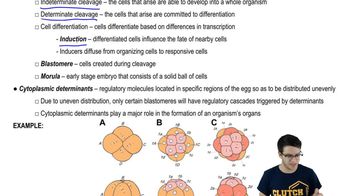
Blastomeres

Blastomeres are the cells formed by the division of the fertilized egg during the early stages of embryonic development. In some species, including humans, early blastomeres have the potential to develop into a complete embryo if they become isolated. This totipotency is crucial for the formation of identical twins, as it allows the separated cells to develop independently into two embryos.
Video consigliato:
07:18
Cleavage and Blastulation

Embryonic Development

Embryonic development is the process by which a fertilized egg transforms into a fully formed organism. It involves multiple stages, including cleavage, blastulation, gastrulation, and organogenesis. Understanding these stages is essential for comprehending how identical twins can form, as the splitting of the embryo typically occurs during the early cleavage stage, when cells are still totipotent.
Video consigliato:
06:02
Embryonic Plant Development