Ch. 47 - Animal Development
Campbell - Campbell Biology 11th Edition
Urry11th EditionCampbell BiologyISBN: 9789357423311Non è quello che usi tu?Cambia libro di testo
Capitolo 47, Problema 4

What structural adaptation in chickens allows them to lay their eggs in arid environments rather than in water?
a. Extraembryonic membranes
b. Yolk
c. Cleavage
d. Gastrulation

Guida verificata passo dopo passo
1
Understand the problem: The question is asking about a structural adaptation in chickens that allows them to lay eggs in arid environments, which means environments with little water.
Identify the key terms: The options provided are 'extraembryonic membranes', 'yolk', 'cleavage', and 'gastrulation'. Each of these terms relates to different aspects of egg development or embryonic development.
Explain 'extraembryonic membranes': These are membranes that form outside the embryo and are crucial for the development of amniotic eggs, which are adapted to terrestrial environments. They include the amnion, chorion, yolk sac, and allantois, which help in gas exchange, waste storage, and nutrient transfer.
Relate the adaptation to the environment: In arid environments, the ability to retain moisture and protect the embryo from desiccation is crucial. The extraembryonic membranes, particularly the amnion, create a protective, water-retaining environment for the developing embryo.
Conclude the reasoning: Based on the explanation, the structural adaptation that allows chickens to lay eggs in arid environments is the presence of extraembryonic membranes, as they provide the necessary protection and support for the embryo in a dry environment.

Risposta video verificata per un problema simile:

Questa soluzione video è stata consigliata dai nostri tutor come utile per risolvere questo problema.
Durata del video:
1m

Concetti chiave

Ecco i concetti essenziali che devi comprendere per rispondere correttamente alla domanda.

Extraembryonic Membranes

Extraembryonic membranes are structures that develop outside the embryo in amniotes, including chickens, to provide protection and support. These membranes include the amnion, chorion, yolk sac, and allantois, which collectively facilitate gas exchange, waste removal, and nutrient transfer, allowing eggs to be laid in terrestrial environments without the need for water.
Video consigliato:
06:04
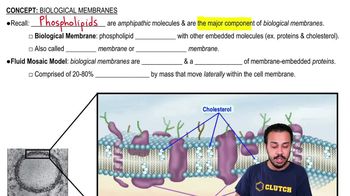
Biological Membranes

Yolk

The yolk is a nutrient-rich part of the egg that provides essential nourishment to the developing embryo. In chickens, the yolk contains proteins, fats, and vitamins necessary for growth, enabling the embryo to develop in a self-contained environment without external food sources, which is crucial for survival in arid conditions.
Video consigliato:
05:58
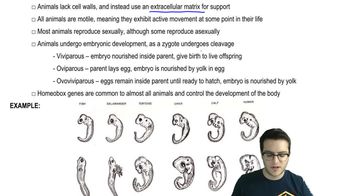
Overview of Animals - 1

Cleavage

Cleavage is the series of rapid cell divisions that occur immediately after fertilization, leading to the formation of a multicellular embryo. In chickens, cleavage is adapted to occur within the confines of the egg, allowing the embryo to develop efficiently in a terrestrial setting, independent of water-based environments.
Video consigliato:
07:18
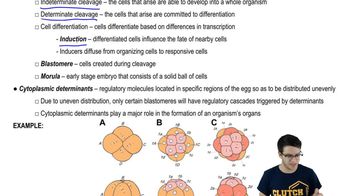
Cleavage and Blastulation
Pratica correlata
Domanda del libro di testo

Which of the following is common to the development of both birds and mammals?

a. Holoblastic cleavage

b. Epiblast and hypoblast

c. Trophoblast

d. Gray crescent

876
views
Domanda del libro di testo

In humans, identical twins are possible because

a. Extraembryonic cells interact with the zygote nucleus.

b. Convergent extension occurs.

c. Early blastomeres can form a complete embryo if isolated.

d. The gray crescent divides the dorsal-ventral axis into new cells.

1442
views
Domanda del libro di testo

Cells transplanted from the neural tube of a frog embryo to the ventral part of another embryo develop into nervous system tissues. This result indicates that the transplanted cells were

a. Totipotent.

b. Determined.

c. Differentiated.

d. Mesenchymal.

1341
views
Domanda del libro di testo

If an egg cell were treated with EDTA, a chemical that binds calcium and magnesium ions,

a. The acrosomal reaction would be blocked.

b. The fusion of sperm and egg nuclei would be blocked.

c. The fast block to polyspermy would not occur.

d. The fertilization envelope would not form.

1374
views
Domanda del libro di testo

The archenteron develops into

a. The mesoderm.

b. The endoderm.

c. The placenta.

d. The lumen of the digestive tract.

1538
views
1
rank
Domanda del libro di testo

The cortical reaction of sea urchin eggs functions directly in

a. The formation of a fertilization envelope.

b. The production of a fast block to polyspermy.

c. The generation of an electrical impulse by the egg.

d. The fusion of egg and sperm nuclei.

1695
views