Ch. 10 - Photosynthesis
Freeman - Biological Science 8th Edition
Freeman8th EditionBiological ScienceISBN: 9780138276263Non è quello che usi tu?Cambia libro di testo
Capitolo 10, Problema 7

Apply what you know of the relationship between the light-capturing reactions and the Calvin cycle to calculate the number of photons used to produce a new G3P and regenerate RuBP. (Assume 1 ATP is produced for each pair of electrons used to form NADPH.)

Guida verificata passo dopo passo
1
Step 1: Understand the relationship between light-capturing reactions and the Calvin cycle. In the light-capturing reactions, light energy is used to produce ATP and NADPH. These are then used in the Calvin cycle to produce G3P and regenerate RuBP.
Step 2: Calculate the number of ATP and NADPH needed to produce a new G3P and regenerate RuBP. For each G3P molecule produced, 9 ATP and 6 NADPH are required. To regenerate RuBP, an additional 3 ATP are needed. So, a total of 12 ATP and 6 NADPH are needed.
Step 3: Calculate the number of photons needed to produce ATP and NADPH. Each ATP requires 2 photons, and each NADPH requires 2 photons (since 1 ATP is produced for each pair of electrons used to form NADPH). Therefore, 24 photons are needed for ATP and 12 photons for NADPH.
Step 4: Add the number of photons needed for ATP and NADPH to get the total number of photons used. So, 24 photons for ATP + 12 photons for NADPH = 36 photons.
Step 5: Therefore, 36 photons are used to produce a new G3P and regenerate RuBP.

Risposta video verificata per un problema simile:

Questa soluzione video è stata consigliata dai nostri tutor come utile per risolvere questo problema.
Durata del video:
53s

Concetti chiave

Ecco i concetti essenziali che devi comprendere per rispondere correttamente alla domanda.

Light-Capturing Reactions

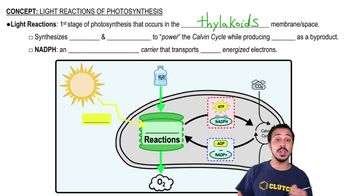
The light-capturing reactions, also known as the light-dependent reactions, occur in the thylakoid membranes of chloroplasts. These reactions convert light energy into chemical energy in the form of ATP and NADPH. Photons are absorbed by chlorophyll, exciting electrons that are transferred through a series of proteins, ultimately leading to the production of ATP and NADPH, which are essential for the subsequent Calvin cycle.
Video consigliato:
04:06
Light Reactions of Photosynthesis

Calvin Cycle

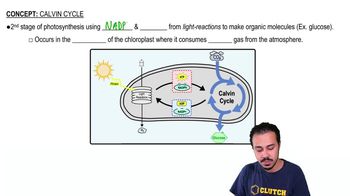
The Calvin cycle, or light-independent reactions, takes place in the stroma of chloroplasts and utilizes ATP and NADPH produced in the light-capturing reactions to convert carbon dioxide into glucose. The cycle involves three main phases: carbon fixation, reduction, and regeneration of RuBP. For every three molecules of CO2 that enter the cycle, one molecule of G3P is produced, which can be used to form glucose and other carbohydrates.
Video consigliato:
03:42
Calvin Cycle

Photon Requirement for G3P Production

To produce one molecule of G3P, the Calvin cycle requires a specific number of ATP and NADPH, which are generated from the light-capturing reactions. Each pair of electrons used to form NADPH corresponds to the absorption of two photons, while ATP production is also linked to photon absorption. Therefore, calculating the total number of photons involves understanding the stoichiometry of ATP and NADPH used in the cycle, as well as their relationship to the number of G3P molecules produced.
Video consigliato:
04:36
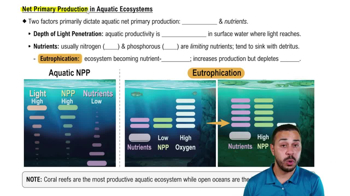
Primary Production in Aquatic Ecosystems