
Ch. 10 - Photosynthesis
Freeman - Biological Science 8th Edition
Freeman8th EditionBiological ScienceISBN: 9780138276263Non è quello che usi tu?Cambia libro di testo
Capitolo 10, Problema 4

At what point in photosynthesis is the electromagnetic energy of light first converted into chemical energy?

Guida verificata passo dopo passo
1
The electromagnetic energy of light is first converted into chemical energy during the 'Light-Dependent Reactions' stage of photosynthesis. This is the first stage of photosynthesis and occurs in the thylakoid membranes of the chloroplasts.
During this stage, chlorophyll and other pigments absorb light energy and convert it into chemical energy in the form of ATP (adenosine triphosphate) and NADPH (nicotinamide adenine dinucleotide phosphate).
The process begins when photons from light hit the chlorophyll molecules, exciting their electrons and causing them to move to a higher energy state.
These high-energy electrons are then transferred through a series of proteins (known as the electron transport chain), which use the energy to pump protons across the thylakoid membrane, creating a proton gradient.
This proton gradient is then used to produce ATP through a process called chemiosmosis, while NADPH is produced by the reduction of NADP+ using the high-energy electrons. Both ATP and NADPH are then used in the second stage of photosynthesis, the 'Light-Independent Reactions' or 'Calvin Cycle', to produce glucose.

Risposta video verificata per un problema simile:

Questa soluzione video è stata consigliata dai nostri tutor come utile per risolvere questo problema.
Durata del video:
30s

Concetti chiave

Ecco i concetti essenziali che devi comprendere per rispondere correttamente alla domanda.

Photosynthesis

Photosynthesis is the biological process by which green plants, algae, and some bacteria convert light energy into chemical energy stored in glucose. This process primarily occurs in the chloroplasts of plant cells and involves two main stages: the light-dependent reactions and the light-independent reactions (Calvin cycle).
Video consigliato:
05:58
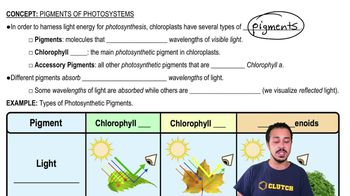
Pigments of Photosynthesis

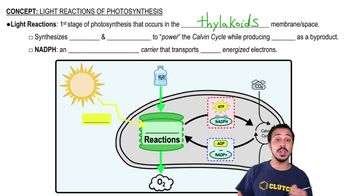
Light-dependent Reactions

The light-dependent reactions are the first stage of photosynthesis, occurring in the thylakoid membranes of chloroplasts. During this phase, chlorophyll absorbs sunlight, which excites electrons and initiates a series of reactions that convert light energy into chemical energy in the form of ATP and NADPH, while also producing oxygen as a byproduct.
Video consigliato:
04:06
Light Reactions of Photosynthesis

Chemical Energy

Chemical energy refers to the energy stored in the bonds of chemical compounds, like glucose. In photosynthesis, the conversion of electromagnetic energy from sunlight into chemical energy occurs during the light-dependent reactions, where ATP and NADPH are generated, providing the energy needed for the subsequent light-independent reactions to synthesize glucose.
Video consigliato:
01:56
Chemical Reactions