Steroid hormones, like most lipid-soluble signaling molecules, are processed directly. How does the absence of a signal transduction cascade in the processing of steroid hormones affect (b) signal regulation?
Ch. 11 - Cell-Cell Interactions
Freeman8th EditionBiological ScienceISBN: 9780138276263Non è quello che usi tu?Cambia libro di testo
Capitolo 11, Problema 9c
Steroid hormones, like most lipid-soluble signaling molecules, are processed directly. How does the absence of a signal transduction cascade in the processing of steroid hormones affect (c) the cellular response that is possible?
Guida verificata passo dopo passo1
Steroid hormones are lipid-soluble, allowing them to pass directly through the cell membrane without the need for a receptor on the cell surface.
Once inside the cell, steroid hormones bind to specific intracellular receptors, forming a hormone-receptor complex.
This hormone-receptor complex then translocates to the cell nucleus, where it can directly interact with DNA to regulate gene expression.
The absence of a signal transduction cascade means that the response is more direct and typically involves changes in gene expression, leading to a slower but more sustained cellular response.
Without a cascade, the amplification of the signal is limited, meaning that the response is proportional to the amount of hormone present, rather than being amplified through a series of enzymatic reactions.

Risposta video verificata per un problema simile:
Questa soluzione video è stata consigliata dai nostri tutor come utile per risolvere questo problema.
Durata del video:
2mConcetti chiave
Ecco i concetti essenziali che devi comprendere per rispondere correttamente alla domanda.
Steroid Hormones
Steroid hormones are lipid-soluble molecules derived from cholesterol. They can easily pass through cell membranes due to their hydrophobic nature. Once inside the cell, they typically bind to specific intracellular receptors, forming a hormone-receptor complex that directly influences gene expression by acting on DNA in the nucleus.
Video consigliato:
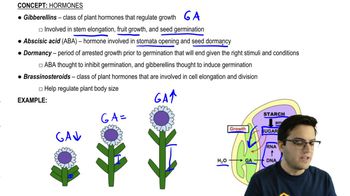
Plant Hormones and Senescence
Signal Transduction Cascade
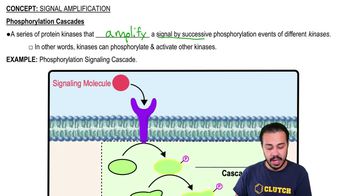
A signal transduction cascade is a series of molecular events initiated by a signal (often a hormone or growth factor) binding to a cell surface receptor. This process typically involves multiple steps, including the activation of proteins and second messengers, leading to a cellular response. The cascade amplifies the signal, allowing for a robust and regulated response to external stimuli.
Video consigliato:
Phosphorylation Cascades
Direct Gene Regulation
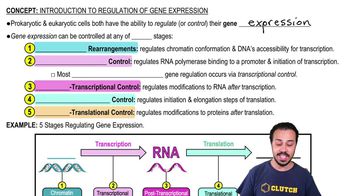
In the absence of a signal transduction cascade, steroid hormones directly regulate gene expression by interacting with intracellular receptors. This direct mechanism allows for a more immediate and specific response, as the hormone-receptor complex can bind directly to DNA, influencing transcription and altering protein synthesis. This can lead to changes in cell function and behavior without the need for intermediate signaling steps.
Video consigliato:
Introduction to Regulation of Gene Expression
Pratica correlata
Domanda del libro di testo
795
views
Domanda del libro di testo
Suppose you have an antibody that binds to the receptor tyrosine kinase illustrated in Figure 11.16. When you add this antibody to the cell, you find that it activates the cell response, even when no signaling molecule is present. Explain this result.
777
views
Domanda del libro di testo
Steroid hormones, like most lipid-soluble signaling molecules, are processed directly. How does the absence of a signal transduction cascade in the processing of steroid hormones affect (a) signal amplification?
1068
views
Domanda del libro di testo
What is the significance of the observation that many signal transduction pathways create a network, where they intersect or overlap?
968
views