Ch. 11 - Cell-Cell Interactions
Freeman - Biological Science 8th Edition
Freeman8th EditionBiological ScienceISBN: 9780138276263Non è quello che usi tu?Cambia libro di testo
Capitolo 11, Problema 8

What is the significance of the observation that many signal transduction pathways create a network, where they intersect or overlap?

Guida verificata passo dopo passo
1
Understanding that many signal transduction pathways create a network where they intersect or overlap highlights the complexity and integration of cellular communication. This network allows cells to respond to multiple signals simultaneously in a coordinated manner.
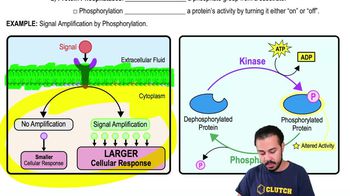
The intersection or overlap of pathways can lead to signal amplification, where a single signal can trigger multiple responses, enhancing the cell's ability to respond to environmental changes efficiently.
This network also provides a mechanism for signal modulation, where the effects of one pathway can be adjusted or fine-tuned by signals from another pathway. This helps in maintaining homeostasis within the cell and the organism.
The overlapping pathways can create redundancies that serve as fail-safes during cellular processes. If one pathway is disrupted, others may still function and carry out necessary activities, ensuring cellular survival and function.
Finally, the network of intersecting pathways allows for evolutionary flexibility and adaptability. It provides a framework that can evolve over time, adding new pathways or modifying existing ones to better respond to the organism's changing environment.

Risposta video verificata per un problema simile:

Questa soluzione video è stata consigliata dai nostri tutor come utile per risolvere questo problema.
Durata del video:
2m

Concetti chiave

Ecco i concetti essenziali che devi comprendere per rispondere correttamente alla domanda.

Signal Transduction Pathways

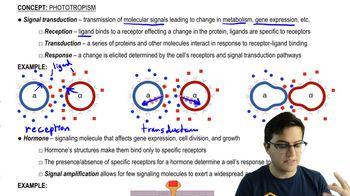
Signal transduction pathways are sequences of molecular events and chemical reactions that lead to a cellular response following the binding of a signaling molecule to a receptor. These pathways are crucial for cells to respond to external stimuli, allowing for processes such as growth, immune responses, and metabolism. Understanding these pathways helps elucidate how cells communicate and coordinate their functions.
Video consigliato:
06:56
Signal Transduction and Response

Network Interactions

In biological systems, network interactions refer to the interconnectedness of various signaling pathways, where multiple pathways can influence each other. This overlap allows for a more integrated response to stimuli, enhancing the cell's ability to adapt to changes in its environment. The complexity of these networks is essential for maintaining homeostasis and ensuring that cellular responses are appropriate and timely.
Video consigliato:
04:25
Interspecific Interactions

Cross-Talk in Signaling

Cross-talk in signaling refers to the phenomenon where different signaling pathways interact and influence one another. This interaction can amplify or inhibit signals, leading to a more nuanced and coordinated cellular response. Understanding cross-talk is vital for comprehending how cells integrate multiple signals to produce a coherent response, which is particularly important in processes like development, immune response, and disease progression.
Video consigliato:
06:10
Signal Amplification
Pratica correlata
Domanda del libro di testo

Steroid hormones, like most lipid-soluble signaling molecules, are processed directly. How does the absence of a signal transduction cascade in the processing of steroid hormones affect (b) signal regulation?

795
views

Domanda del libro di testo

Steroid hormones, like most lipid-soluble signaling molecules, are processed directly. How does the absence of a signal transduction cascade in the processing of steroid hormones affect (a) signal amplification?

1068
views
Domanda del libro di testo

Summarize the experimental evidence in sponges showing that animal cells adhere to each other selectively. Explain the molecular basis of selective adhesion.

904
views
Domanda del libro di testo

Suppose you were to model amplification by the phosphorylation cascade in Figure 11.16, using a penny for each kinase 1, a nickel for each kinase 2, and a dime for each kinase 3. Also suppose that Ras and each of the kinases can activate 10 proteins. How much money would you need to construct your model?

650
views
Domanda del libro di testo

Steroid hormones, like most lipid-soluble signaling molecules, are processed directly. How does the absence of a signal transduction cascade in the processing of steroid hormones affect (c) the cellular response that is possible?

863
views
Domanda del libro di testo

How do the extracellular filaments in plants differ from those in animals?

a. Plant filaments resist compression forces; animal filaments resist pulling forces.

b. Animal filaments consist of proteins; plant filaments consist of polysaccharides.

c. Plant extracellular filaments never move; animal filaments can slide past one another.

d. Plant filaments run parallel to one another; animal filaments crisscross.

2409
views