Ch. 11 - Cell-Cell Interactions
Freeman - Biological Science 8th Edition
Freeman8th EditionBiological ScienceISBN: 9780138276263Non è quello che usi tu?Cambia libro di testo
Capitolo 11, Problema 7

Suppose you were to model amplification by the phosphorylation cascade in Figure 11.16, using a penny for each kinase 1, a nickel for each kinase 2, and a dime for each kinase 3. Also suppose that Ras and each of the kinases can activate 10 proteins. How much money would you need to construct your model?

Guida verificata passo dopo passo
1
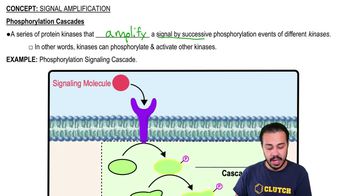
Identify the number of each type of kinase at each step of the cascade. Since each kinase can activate 10 proteins, and there are 3 steps in the cascade, calculate the total number of kinases activated at each step. Start with 1 Ras activating 10 kinase 1, each kinase 1 activates 10 kinase 2, and each kinase 2 activates 10 kinase 3.
Calculate the total number of kinase 1, kinase 2, and kinase 3. Kinase 1: 10, Kinase 2: 10 x 10 = 100, Kinase 3: 10 x 100 = 1000.
Determine the monetary value of each type of kinase. Use a penny (1 cent) for each kinase 1, a nickel (5 cents) for each kinase 2, and a dime (10 cents) for each kinase 3.
Calculate the total cost for each type of kinase. Cost for kinase 1: 10 pennies = 10 cents, Cost for kinase 2: 100 nickels = 100 x 5 = 500 cents, Cost for kinase 3: 1000 dimes = 1000 x 10 = 10000 cents.
Add up the total cost for all kinases to find out how much money you would need for the model. Total cost = 10 cents (kinase 1) + 500 cents (kinase 2) + 10000 cents (kinase 3) = 10510 cents or \$105.10.

Risposta video verificata per un problema simile:

Questa soluzione video è stata consigliata dai nostri tutor come utile per risolvere questo problema.
Durata del video:
2m

Concetti chiave

Ecco i concetti essenziali che devi comprendere per rispondere correttamente alla domanda.

Phosphorylation Cascade

A phosphorylation cascade is a series of biochemical events where one enzyme phosphorylates another, leading to a chain reaction that amplifies a signal within a cell. This process is crucial in cellular signaling pathways, allowing a small initial signal to produce a large response, often involving multiple kinases that sequentially activate each other.
Video consigliato:
02:35
Phosphorylation Cascades

Kinases

Kinases are enzymes that catalyze the transfer of phosphate groups from high-energy molecules, like ATP, to specific substrates, typically proteins. This phosphorylation can alter the activity, localization, or function of the target proteins, playing a vital role in regulating various cellular processes, including metabolism, cell division, and signal transduction.
Video consigliato:
02:35
Phosphorylation Cascades

Signal Amplification

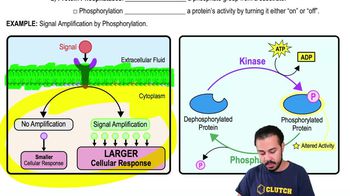
Signal amplification refers to the process by which a small initial signal is greatly increased through a series of biochemical reactions, often involving kinases and other signaling molecules. In the context of the phosphorylation cascade, each activated kinase can trigger the activation of multiple downstream proteins, resulting in a significant enhancement of the cellular response to the original signal.
Video consigliato:
06:10
Signal Amplification
Pratica correlata
Domanda del libro di testo

Steroid hormones, like most lipid-soluble signaling molecules, are processed directly. How does the absence of a signal transduction cascade in the processing of steroid hormones affect (b) signal regulation?

795
views

Domanda del libro di testo

Steroid hormones, like most lipid-soluble signaling molecules, are processed directly. How does the absence of a signal transduction cascade in the processing of steroid hormones affect (a) signal amplification?

1068
views
Domanda del libro di testo

Summarize the experimental evidence in sponges showing that animal cells adhere to each other selectively. Explain the molecular basis of selective adhesion.

904
views
Domanda del libro di testo

What is the significance of the observation that many signal transduction pathways create a network, where they intersect or overlap?

968
views
Domanda del libro di testo

What does it mean to say that a signal is transduced?

a. The signaling molecule enters the cell directly and elicits a cellular response.

b. The signal is generated by the production of proteins.

c. The physical form of the signal changes between the outside of the cell and the inside.

d. The signal is amplified.

1042
views
Domanda del libro di testo

How do the extracellular filaments in plants differ from those in animals?

a. Plant filaments resist compression forces; animal filaments resist pulling forces.

b. Animal filaments consist of proteins; plant filaments consist of polysaccharides.

c. Plant extracellular filaments never move; animal filaments can slide past one another.

d. Plant filaments run parallel to one another; animal filaments crisscross.

2407
views