Ch. 12 - The Cell Cycle
Freeman - Biological Science 8th Edition
Freeman8th EditionBiological ScienceISBN: 9780138276263Non è quello che usi tu?Cambia libro di testo
Capitolo 12, Problema 8

Compare and contrast the effects of removing growth factors from asynchronous cultures of human cells that are normal and those that are cancerous.

Guida verificata passo dopo passo
1
Identify the role of growth factors: Growth factors are proteins that stimulate cell division and proliferation. They bind to specific receptors on the cell surface, triggering a cascade of cellular processes that lead to cell growth and division.
Understand the behavior of normal human cells: In normal cells, growth factors ensure controlled cell division. When growth factors are removed, normal cells typically enter a quiescent state (G0 phase) where they are metabolically active but not dividing, maintaining tissue homeostasis.
Examine the behavior of cancerous human cells: Cancer cells often exhibit uncontrolled growth and division due to mutations in genes that regulate the cell cycle. These mutations can lead to independence from growth factors, allowing cancer cells to proliferate even in their absence.
Compare the effects of removing growth factors: When growth factors are removed, normal cells stop dividing and enter a quiescent state, whereas cancerous cells may continue to divide due to their growth factor independence.
Discuss the implications for cancer treatment: Understanding the differential responses to growth factor removal can help in designing targeted therapies. For example, therapies that inhibit growth factor signaling pathways might be effective in treating cancers that still depend on external growth factors.

Risposta video verificata per un problema simile:

Questa soluzione video è stata consigliata dai nostri tutor come utile per risolvere questo problema.
Durata del video:
1m

Concetti chiave

Ecco i concetti essenziali che devi comprendere per rispondere correttamente alla domanda.

Growth Factors

Growth factors are proteins that stimulate cell proliferation, differentiation, and survival. They bind to specific receptors on the cell surface, triggering signaling pathways that promote various cellular functions. In normal cells, growth factors are essential for regulating the cell cycle and maintaining tissue homeostasis, while in cancerous cells, they can contribute to uncontrolled growth and survival.
Video consigliato:
00:51
Factors Limiting Population Growth

Asynchronous Cell Cultures

Asynchronous cell cultures consist of cells at various stages of the cell cycle, rather than synchronized at a specific phase. This model reflects more closely the behavior of cells in vivo, where they are not all dividing at the same time. Studying asynchronous cultures allows researchers to observe how different cell types respond to external factors, such as the absence of growth factors, in a more realistic context.
Video consigliato:
05:33
Cell Junctions

Cell Cycle Regulation

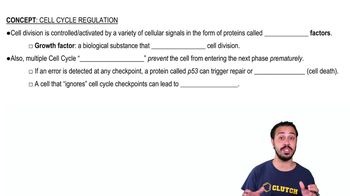
The cell cycle is a series of phases that a cell goes through to divide and replicate. It is tightly regulated by various checkpoints and proteins, including cyclins and cyclin-dependent kinases. In normal cells, the removal of growth factors can lead to cell cycle arrest, preventing division, while cancerous cells often bypass these regulatory mechanisms, allowing them to continue proliferating despite the absence of growth factors.
Video consigliato:
03:31
Cell Cycle Regulation