Ch. 12 - The Cell Cycle
Freeman - Biological Science 8th Edition
Freeman8th EditionBiological ScienceISBN: 9780138276263Non è quello che usi tu?Cambia libro di testo
Capitolo 12, Problema 6

What evidence suggests that during anaphase, kinetochore microtubules shorten at the kinetochore?

Guida verificata passo dopo passo
1
Step 1: Understand the question. The question is asking for evidence that suggests that during anaphase, kinetochore microtubules shorten at the kinetochore. Anaphase is a stage in mitosis and meiosis where the chromosomes separate. Kinetochore microtubules are structures that help in this separation process.
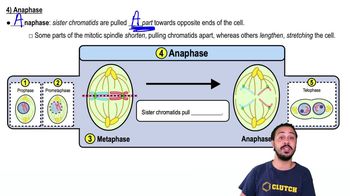
Step 2: Recall what happens during anaphase. During anaphase, the sister chromatids separate and move towards opposite poles of the cell. This movement is facilitated by the kinetochore microtubules.
Step 3: Consider the evidence. One piece of evidence is the observation that during anaphase, the kinetochores remain stationary relative to the poles of the cell, even as the chromosomes move towards the poles. This suggests that the microtubules are shortening at the kinetochore, pulling the chromosomes along.
Step 4: Consider additional evidence. Another piece of evidence comes from experiments where fluorescent markers are used to label the ends of the microtubules. These experiments show that the ends of the microtubules at the kinetochore become less fluorescent over time, indicating that they are shortening.
Step 5: Summarize the evidence. The stationary position of the kinetochores relative to the poles of the cell and the decrease in fluorescence at the ends of the microtubules both suggest that during anaphase, kinetochore microtubules shorten at the kinetochore.

Risposta video verificata per un problema simile:

Questa soluzione video è stata consigliata dai nostri tutor come utile per risolvere questo problema.
Durata del video:
2m

Concetti chiave

Ecco i concetti essenziali che devi comprendere per rispondere correttamente alla domanda.

Anaphase

Anaphase is a stage in mitosis where sister chromatids are pulled apart toward opposite poles of the cell. This process is crucial for ensuring that each daughter cell receives an identical set of chromosomes. During anaphase, the cohesin proteins that hold the sister chromatids together are cleaved, allowing the microtubules to exert force and facilitate their movement.
Video consigliato:
02:39
Anaphase

Kinetochore Microtubules

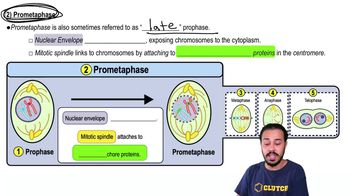
Kinetochore microtubules are specialized structures that connect the spindle apparatus to the kinetochore, a protein complex assembled on the centromere of each chromosome. These microtubules play a vital role in chromosome movement during cell division by attaching to the kinetochores and pulling the chromatids apart. Their dynamic nature allows them to grow and shorten, which is essential for the proper segregation of chromosomes.
Video consigliato:
03:20
Prometaphase

Microtubule Dynamics

Microtubule dynamics refer to the continuous process of growth and shrinkage of microtubules, driven by the addition and loss of tubulin subunits. During anaphase, evidence suggests that kinetochore microtubules shorten as they pull chromatids toward the poles. This shortening is thought to be facilitated by depolymerization at the kinetochore end, which generates the force necessary for chromatid movement.
Video consigliato:
03:37
Disturbances Make Communities Dynamic