Ch. 15 - DNA and the Gene: Synthesis and Repair
Freeman - Biological Science 8th Edition
Freeman8th EditionBiological ScienceISBN: 9780138276263Non è quello che usi tu?Cambia libro di testo
Capitolo 15, Problema 7

How does telomerase prevent linear chromosomes from shortening during replication?

Guida verificata passo dopo passo
1
Understand the structure of chromosomes: Chromosomes are made up of DNA and proteins, and they have structures called telomeres at their ends. Telomeres consist of repetitive sequences of DNA that do not code for any proteins but serve as protective caps to prevent the loss of important genetic information during cell division.
Recognize the problem of DNA replication: During DNA replication, the enzymes that copy DNA cannot replicate the very end of the chromosome, which leads to the shortening of the chromosome each time a cell divides. This shortening can eventually lead to the loss of vital genetic information if not counteracted.
Learn about the role of telomerase: Telomerase is an enzyme that adds repetitive nucleotide sequences to the ends of the telomeres. This enzyme includes a component that serves as a template for adding DNA sequences, thus extending the telomeres.
Connect telomerase activity to chromosome protection: By extending the telomeres, telomerase ensures that the shortening of chromosomes during replication does not reach the regions containing essential genes. This activity is crucial for maintaining the integrity and length of the chromosome over successive cell divisions.
Explore the implications of telomerase activity: Telomerase is particularly active in stem cells and cancer cells, allowing them to divide many times without DNA damage. Understanding telomerase and its regulation is important for insights into aging and cancer.

Risposta video verificata per un problema simile:

Questa soluzione video è stata consigliata dai nostri tutor come utile per risolvere questo problema.
Durata del video:
2m

Concetti chiave

Ecco i concetti essenziali che devi comprendere per rispondere correttamente alla domanda.

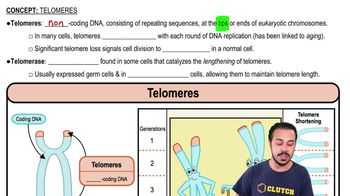
Telomeres

Telomeres are repetitive nucleotide sequences located at the ends of linear chromosomes. They protect the chromosome from deterioration or fusion with neighboring chromosomes. Each time a cell divides, telomeres shorten, which can eventually lead to cellular aging and loss of genetic information.
Video consigliato:
04:25
Telomeres

Telomerase

Telomerase is an enzyme that adds nucleotide sequences to the ends of telomeres, counteracting the shortening that occurs during DNA replication. It is particularly active in stem cells and cancer cells, allowing them to maintain their telomere length and continue dividing beyond normal limits.
Video consigliato:
04:25
Telomeres

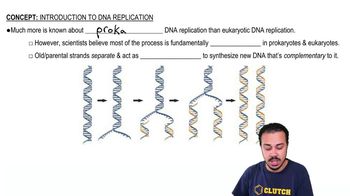
DNA Replication

DNA replication is the process by which a cell duplicates its DNA before cell division. During this process, the DNA strands are unwound and each strand serves as a template for synthesizing a new complementary strand. However, the mechanism of replication can lead to the loss of telomeric DNA, which is where telomerase plays a crucial role.
Video consigliato:
03:37
Introduction to DNA Replication