Ch. 15 - DNA and the Gene: Synthesis and Repair
Freeman - Biological Science 8th Edition
Freeman8th EditionBiological ScienceISBN: 9780138276263Non è quello che usi tu?Cambia libro di testo
Capitolo 15, Problema 8a

What aspect of DNA structure makes it possible for the proteins of nucleotide excision repair to recognize many different types of DNA damage?
(a) the polarity of each DNA strand

Guida verificata passo dopo passo
1
Understand the basic structure of DNA: DNA is composed of two strands forming a double helix, with each strand consisting of a sugar-phosphate backbone and nitrogenous bases (adenine, thymine, cytosine, and guanine) paired through hydrogen bonds.
Recognize the concept of DNA polarity: Each DNA strand has a directionality or polarity, defined by the orientation of the sugar-phosphate backbone. One end of the strand is the 5' end, and the other is the 3' end, which is crucial for various biological processes.
Explore nucleotide excision repair (NER): NER is a DNA repair mechanism that identifies and removes damaged nucleotides, replacing them with the correct ones. It is versatile and can recognize a wide range of DNA damage types, such as UV-induced thymine dimers and bulky adducts.
Identify how DNA structure aids NER: The regularity and uniformity of the DNA double helix allow repair proteins to detect distortions or irregularities in the structure, which often indicate damage. The polarity of the strands helps guide the repair process, ensuring the correct orientation for excision and synthesis.
Consider the role of DNA strand polarity in repair: The polarity of each strand ensures that the repair machinery can correctly identify the damaged site and orient the repair synthesis in the proper direction, maintaining the integrity of the genetic information.

Risposta video verificata per un problema simile:

Questa soluzione video è stata consigliata dai nostri tutor come utile per risolvere questo problema.
Durata del video:
46s

Concetti chiave

Ecco i concetti essenziali che devi comprendere per rispondere correttamente alla domanda.

DNA Structure

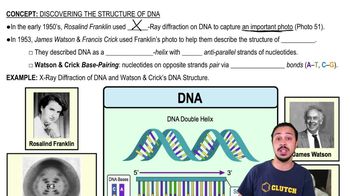
DNA is composed of two strands forming a double helix, with each strand consisting of a sugar-phosphate backbone and nitrogenous bases. The specific pairing of bases (adenine with thymine, and cytosine with guanine) allows for the recognition and repair of mismatches or damage, as the structure is altered when errors occur.
Video consigliato:
04:41
Discovering the Structure of DNA

Nucleotide Excision Repair

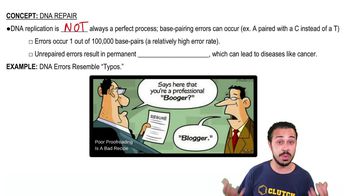
Nucleotide excision repair is a mechanism that identifies and removes damaged sections of DNA. It is versatile in recognizing various types of damage, such as bulky adducts or thymine dimers, by detecting distortions in the DNA helix, which are indicative of structural anomalies.
Video consigliato:
03:20
DNA Repair

Polarity of DNA Strands

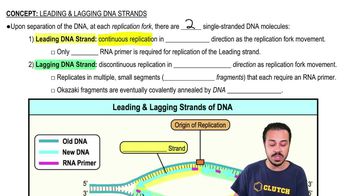
The polarity of DNA strands refers to the orientation of the sugar-phosphate backbone, with one strand running 5' to 3' and the other 3' to 5'. This antiparallel arrangement is crucial for replication and repair processes, as it ensures that enzymes can correctly identify and process the strands during repair.
Video consigliato:
05:15
Leading & Lagging DNA Strands
Pratica correlata
Domanda del libro di testo

What aspect of DNA structure makes it possible for the proteins of nucleotide excision repair to recognize many different types of DNA damage?

(b) the antiparallel orientation of strands in the double helix

2309
views

Domanda del libro di testo

Researchers design experiments so that only one thing is different between the treatments that are being compared. In the Hershey–Chase experiment, what was this single difference?

800
views
Domanda del libro di testo

How does telomerase prevent linear chromosomes from shortening during replication?

774
views
Domanda del libro di testo

Analyze the following statements about DNA synthesis. Select True or False for each statement.

T/FAn RNA polymerase is essential for DNA synthesis.

T/FOkazaki fragments would be unnecessary if DNA polymerase could synthesize DNA in both the 3'→5' and 5'→3' directions.

T/FDNA ligase is used more frequently on the lagging strand than on the leading strand.

T/FToposiomerase is required to separate the two strands of DNA at the replication fork.

2279
views
Domanda del libro di testo

What aspect of DNA structure makes it possible for the proteins of nucleotide excision repair to recognize many different types of DNA damage?

(c) the energy differences between correct and incorrect base pairs

2170
views
Domanda del libro di testo

What aspect of DNA structure makes it possible for the proteins of nucleotide excision repair to recognize many different types of DNA damage?

(d) the regularity of DNA's structure

2238
views