Ch. 15 - DNA and the Gene: Synthesis and Repair
Freeman - Biological Science 8th Edition
Freeman8th EditionBiological ScienceISBN: 9780138276263Non è quello che usi tu?Cambia libro di testo
Capitolo 15, Problema 8d

What aspect of DNA structure makes it possible for the proteins of nucleotide excision repair to recognize many different types of DNA damage?
(d) the regularity of DNA's structure

Guida verificata passo dopo passo
1
Understand the basic structure of DNA: DNA is composed of two strands forming a double helix, with a backbone made of sugar and phosphate groups, and nitrogenous bases (adenine, thymine, cytosine, and guanine) paired in the center.
Recognize the regularity of DNA's structure: The double helix has a consistent diameter and uniform spacing between the base pairs, which contributes to its regularity.
Learn about nucleotide excision repair: This is a DNA repair mechanism that identifies and removes damaged sections of DNA, replacing them with the correct nucleotides.
Consider how the regularity aids repair: The consistent structure of DNA allows repair proteins to easily detect irregularities or distortions caused by damage, as these deviations stand out against the uniform background.
Explore the role of repair proteins: These proteins scan the DNA for structural anomalies, and the regularity of the DNA helix makes it easier for them to identify and bind to damaged sites, facilitating the repair process.

Risposta video verificata per un problema simile:

Questa soluzione video è stata consigliata dai nostri tutor come utile per risolvere questo problema.
Durata del video:
49s

Concetti chiave

Ecco i concetti essenziali che devi comprendere per rispondere correttamente alla domanda.

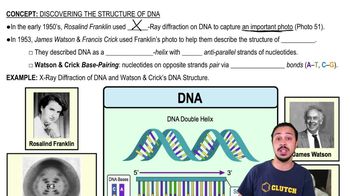
DNA Structure

DNA is composed of two strands forming a double helix, with a backbone of sugar-phosphate and nitrogenous bases paired in the center. This regular and predictable structure allows for consistent recognition by repair proteins, as any deviation from the norm can indicate damage.
Video consigliato:
04:41
Discovering the Structure of DNA

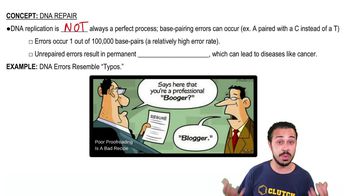
Nucleotide Excision Repair

Nucleotide excision repair is a DNA repair mechanism that identifies and removes damaged sections of DNA. It relies on the ability to detect irregularities in the DNA structure, such as distortions caused by chemical modifications or UV-induced lesions, to initiate repair processes.
Video consigliato:
03:20
DNA Repair

DNA Damage Recognition

Proteins involved in DNA repair recognize damage by detecting structural anomalies in the DNA helix. The regularity of DNA's structure provides a baseline for these proteins to identify disruptions, enabling them to target and repair a wide range of damage types effectively.
Video consigliato:
04:01
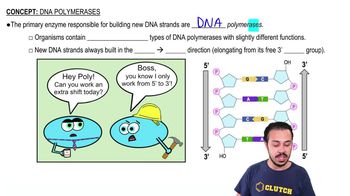
DNA Polymerases
Pratica correlata
Domanda del libro di testo

What aspect of DNA structure makes it possible for the proteins of nucleotide excision repair to recognize many different types of DNA damage?

(b) the antiparallel orientation of strands in the double helix

2311
views

Domanda del libro di testo

The graph that follows shows the survival of four different E. coli strains after exposure to increasing doses of ultraviolet light. The wild-type strain is normal, but the other strains have a mutation in either a gene called uvrA, a gene called recA, or both.

(a) Which strains are most sensitive to UV light? Which strains are least sensitive?

2214
views
Domanda del libro di testo

What aspect of DNA structure makes it possible for the proteins of nucleotide excision repair to recognize many different types of DNA damage?

(a) the polarity of each DNA strand

2205
views
Domanda del libro di testo

In the late 1950s, Herbert Taylor grew bean root-tip cells in a solution of radioactive thymidine (a precursor to one of the deoxyribonucleotides in DNA) and allowed them to undergo one round of DNA replication. He then transferred the cells to a solution without radioactive thymidine, allowed them to replicate again, and examined their chromosomes for the presence of radioactivity. His results are shown in the following figure, where red indicates a radioactive chromatid.

(a) Draw labeled diagrams of double-stranded DNA molecules that explain the pattern of radioactivity observed in the sister chromatids after the first and second rounds of replication.

724
views
Domanda del libro di testo

In the late 1950s, Herbert Taylor grew bean root-tip cells in a solution of radioactive thymidine (a precursor to one of the deoxyribonucleotides in DNA) and allowed them to undergo one round of DNA replication. He then transferred the cells to a solution without radioactive thymidine, allowed them to replicate again, and examined their chromosomes for the presence of radioactivity. His results are shown in the following figure, where red indicates a radioactive chromatid.

(b) What would the results of Taylor's experiment be if eukaryotes used a conservative mode of DNA replication?

1034
views
Domanda del libro di testo

What aspect of DNA structure makes it possible for the proteins of nucleotide excision repair to recognize many different types of DNA damage?

(c) the energy differences between correct and incorrect base pairs

2179
views