
Ch. 2 - Water and Carbon: The Chemical Basis of Life
Freeman - Biological Science 8th Edition
Freeman8th EditionBiological ScienceISBN: 9780138276263Non è quello che usi tu?Cambia libro di testo
Capitolo 2, Problema 4

What factors determine whether a chemical reaction is spontaneous or not?

Guida verificata passo dopo passo
1
Understand that the spontaneity of a chemical reaction is determined by the Gibbs free energy change (ΔG). A reaction is spontaneous if ΔG < 0 (negative).
Recall the formula for Gibbs free energy: ΔG = ΔH - TΔS, where ΔH is the change in enthalpy, T is the temperature in Kelvin, and ΔS is the change in entropy.
Analyze the role of enthalpy (ΔH): If ΔH is negative (exothermic reaction), it favors spontaneity. If ΔH is positive (endothermic reaction), it works against spontaneity.
Consider the role of entropy (ΔS): If ΔS is positive (increase in disorder), it favors spontaneity. If ΔS is negative (decrease in disorder), it works against spontaneity.
Evaluate the temperature (T): At higher temperatures, the TΔS term becomes more significant. This means that reactions with a positive ΔS are more likely to be spontaneous at higher temperatures, while reactions with a negative ΔS may require lower temperatures to be spontaneous.

Risposta video verificata per un problema simile:

Questa soluzione video è stata consigliata dai nostri tutor come utile per risolvere questo problema.
Durata del video:
49s

Concetti chiave

Ecco i concetti essenziali che devi comprendere per rispondere correttamente alla domanda.

Gibbs Free Energy

Gibbs Free Energy (G) is a thermodynamic potential that helps predict whether a chemical reaction will occur spontaneously at constant temperature and pressure. A reaction is spontaneous if the change in Gibbs Free Energy (ΔG) is negative, indicating that the products have lower energy than the reactants. This concept integrates both enthalpy and entropy, providing a comprehensive criterion for spontaneity.
Video consigliato:
04:58
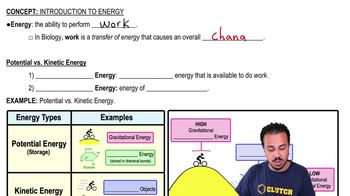
Introduction to Energy

Enthalpy and Entropy

Enthalpy (H) is a measure of the total heat content of a system, while entropy (S) quantifies the degree of disorder or randomness. The relationship between these two properties is crucial in determining spontaneity. A reaction can be spontaneous if it releases heat (exothermic, ΔH < 0) or increases disorder (ΔS > 0), or both, as reflected in the Gibbs Free Energy equation: ΔG = ΔH - TΔS.
Video consigliato:
03:21
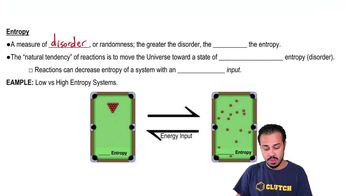
Entropy

Temperature's Role

Temperature (T) plays a significant role in determining the spontaneity of a reaction, particularly through its influence on entropy. As temperature increases, the impact of entropy on Gibbs Free Energy becomes more pronounced. For reactions where entropy increases (ΔS > 0), higher temperatures can favor spontaneity, even if the reaction is endothermic (ΔH > 0), making temperature a critical factor in the spontaneity of chemical reactions.
Video consigliato:
05:42
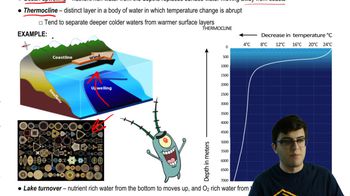
Temperature in Aquatic Biomes
Pratica correlata
Domanda del libro di testo

Which of the following occurs when a covalent bond forms?


a. Electrons in valence shells are transferred from one atom to another.

b. Electrons in valence shells are shared between atoms.

c. Partial charges on polar molecules interact.

385
views
Domanda del libro di testo

What are the defining characteristics of a condensation reaction?

a. Two monomers are covalently bonded together and a water molecule is produced.

b. Two monomers are covalently bonded together and a water molecule is used up.

c. A polymer is broken down into monomers and a water molecule is produced.

d. A polymer is broken down into monomers and a water molecule is used up.

2007
views
1
rank
Domanda del libro di testo

Which of these functional groups is known to be used for storing large amounts of chemical energy?

a. Amino group

b. Carbonyl group

c. Phosphate group

d. Sulfhydryl group

2129
views
Domanda del libro di testo

If you were given a solution that has a pH of 8.5, what would be its concentration of protons? What is the difference in proton concentration between this solution and one that has a pH of 7?

3634
views
Domanda del libro di testo

Which of these molecules would you predict to have the largest number of polar covalent bonds based on their molecular formulas?

a. C2H6O(ethanol)

b. C2H6(ethane)

c. C2H4O2(acetic acid)

d. C3H8O (propanol)

1468
views
Domanda del libro di testo

Locate fluorine (F) on the partial periodic table provided in Figure 2.2. Predict its relative electronegativity compared to hydrogen, sodium, and oxygen. State the number and type of bond(s) you expect it would form if it reacted with sodium (Na).

2567
views