
Ch. 2 - Water and Carbon: The Chemical Basis of Life
Freeman - Biological Science 8th Edition
Freeman8th EditionBiological ScienceISBN: 9780138276263Non è quello che usi tu?Cambia libro di testo
Capitolo 2, Problema 3

Which of these functional groups is known to be used for storing large amounts of chemical energy?
a. Amino group
b. Carbonyl group
c. Phosphate group
d. Sulfhydryl group

Guida verificata passo dopo passo
1
Identify the functional groups listed in the problem: amino group, carbonyl group, phosphate group, and sulfhydryl group.
Understand the role of each functional group in biological molecules: Amino groups are found in amino acids, carbonyl groups are found in ketones and aldehydes, phosphate groups are found in ATP and nucleotides, and sulfhydryl groups are found in thiols.
Recall that the phosphate group is a key component of ATP (adenosine triphosphate), which is the primary energy carrier in cells.
Recognize that the high-energy bonds between phosphate groups in ATP store and release energy during cellular processes.
Conclude that the phosphate group is known for storing large amounts of chemical energy, making it the correct answer.

Risposta video verificata per un problema simile:

Questa soluzione video è stata consigliata dai nostri tutor come utile per risolvere questo problema.
Durata del video:
1m

Concetti chiave

Ecco i concetti essenziali che devi comprendere per rispondere correttamente alla domanda.

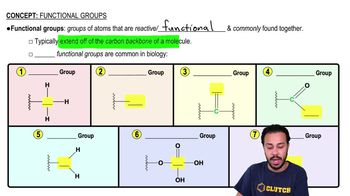
Functional Groups

Functional groups are specific groups of atoms within molecules that have characteristic properties and reactivity. They play a crucial role in the chemical behavior of organic compounds, influencing molecular interactions and reactions. Understanding functional groups is essential for predicting the properties and functions of molecules in biological systems.
Video consigliato:
06:04
Functional Groups

Phosphate Group

The phosphate group consists of a phosphorus atom bonded to four oxygen atoms and is known for its role in storing and transferring energy in biological systems. It is a key component of ATP (adenosine triphosphate), the primary energy carrier in cells, where the high-energy bonds between phosphate groups are used to fuel cellular processes.
Video consigliato:
06:04
Functional Groups

Chemical Energy Storage

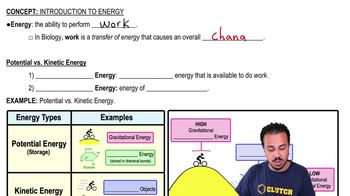
Chemical energy storage involves the accumulation of energy in chemical bonds, which can be released during chemical reactions. In biological systems, molecules like ATP store energy in their phosphate bonds, which can be harnessed for various cellular activities. Understanding how energy is stored and released is fundamental to studying metabolism and energy transfer in cells.
Video consigliato:
04:58
Introduction to Energy