
Ch. 27 - Diversification of Eukaryotes
Freeman - Biological Science 8th Edition
Freeman8th EditionBiological ScienceISBN: 9780138276263Non è quello che usi tu?Cambia libro di testo
Capitolo 27, Problema 6

Consider the endosymbiosis theory for the origin of the mitochondrion. How did each endosymbiotic partner benefit from the relationship?

Guida verificata passo dopo passo
1
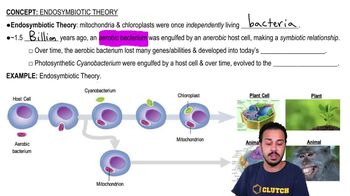
Understand the endosymbiosis theory: This theory suggests that mitochondria originated from free-living prokaryotes that were engulfed by an ancestral eukaryotic cell. Over time, a symbiotic relationship developed.
Identify the benefits for the engulfed prokaryote: The engulfed prokaryote, which eventually became the mitochondrion, benefited from a stable environment and access to nutrients provided by the host cell.
Identify the benefits for the host eukaryotic cell: The host cell benefited from the engulfed prokaryote's ability to perform aerobic respiration, which allowed for more efficient ATP production compared to anaerobic processes.
Consider the mutualistic relationship: Both the host cell and the engulfed prokaryote gained advantages that enhanced their survival and reproduction, leading to a mutually beneficial relationship.
Reflect on the evolutionary significance: This symbiotic relationship was crucial in the evolution of complex eukaryotic cells, allowing them to become more energy-efficient and paving the way for the development of multicellular organisms.

Risposta video verificata per un problema simile:

Questa soluzione video è stata consigliata dai nostri tutor come utile per risolvere questo problema.
Durata del video:
3m

Concetti chiave

Ecco i concetti essenziali che devi comprendere per rispondere correttamente alla domanda.

Endosymbiosis Theory

The endosymbiosis theory suggests that mitochondria originated from free-living prokaryotes that entered into a symbiotic relationship with ancestral eukaryotic cells. This theory is supported by evidence such as the presence of double membranes and their own DNA in mitochondria, which resemble those of certain bacteria, indicating a shared evolutionary history.
Video consigliato:
06:58
Endosymbiotic Theory

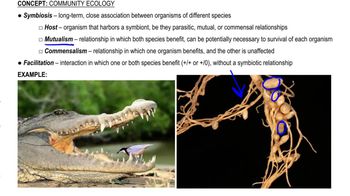
Mutualistic Symbiosis

Mutualistic symbiosis is a type of symbiotic relationship where both partners benefit. In the context of endosymbiosis, the host eukaryotic cell gained enhanced energy production capabilities through the mitochondrion's ability to perform aerobic respiration, while the engulfed prokaryote received protection and access to a rich nutrient environment within the host cell.
Video consigliato:
02:34
Symbiosis

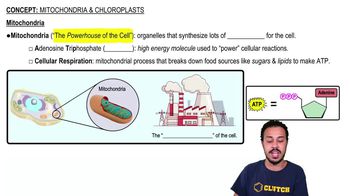
Mitochondrial Function

Mitochondria are known as the powerhouses of the cell due to their role in producing ATP through oxidative phosphorylation. This function is crucial for eukaryotic cells as it provides the energy necessary for various cellular processes. The acquisition of mitochondria allowed ancestral eukaryotic cells to exploit oxygen more efficiently, leading to increased energy production and evolutionary advantages.
Video consigliato:
04:19
Mitochondria
Pratica correlata
Domanda del libro di testo

Consider the following:

Plasmodium has an unusual organelle called an apicoplast. Recent research has shown that apicoplasts are derived from chloroplasts via secondary endosymbiosis and have a large number of genes related to chloroplast DNA.

Glyphosate is one of the most widely used herbicides. It works by poisoning an enzyme located in chloroplasts.

Biologists are testing the hypothesis that glyphosate could be used as an antimalarial drug in humans.

How are these observations connected?

623
views
Domanda del libro di testo

The text claims that the evolutionary history of protists can be understood as a series of morphological innovations that established seven distinct lineages, each of which subsequently diversified based on innovative ways of feeding, moving, and reproducing. Explain how the Alveolata support this claim.

791
views
Domanda del libro di testo

Evaluate the following statements regarding motility in protists. Select True or False for each statement.

T/F Amoeboid motion is common in species with cell walls.

T/F Some protists use flagella to swim.

T/F Some protists use cilia to swim, which are shorter and more numerous than flagella.

T/F Amoeboid motion requires ATP and interactions between the proteins actin and myosin.

758
views
Domanda del libro di testo

Why was finding a close relationship between mitochondrial DNA and bacterial DNA considered particularly strong evidence in favor of the endosymbiosis theory?

2365
views
Domanda del libro di testo

How can dinoflagellates be harmful to humans? a. They are transmitted by mosquitoes and cause malaria. b. They produce toxins that can be absorbed by clams and other shellfish which, when eaten by people, can lead to paralytic shellfish poisoning. c. They cause amoebic dysentery which leads to severe diarrhea and dehydration. d. They are transmitted by tsetse flies and cause 'sleeping sickness.'

552
views
Domanda del libro di testo

Explain the logic behind the claim that the nuclear envelope is a synapomorphy that defines eukaryotes as a monophyletic group.

658
views