Ch. 27 - Diversification of Eukaryotes
Freeman - Biological Science 8th Edition
Freeman8th EditionBiological ScienceISBN: 9780138276263Non è quello che usi tu?Cambia libro di testo
Capitolo 27, Problema 3

Evaluate the following statements regarding motility in protists. Select True or False for each statement.
T/F Amoeboid motion is common in species with cell walls.
T/F Some protists use flagella to swim.
T/F Some protists use cilia to swim, which are shorter and more numerous than flagella.
T/F Amoeboid motion requires ATP and interactions between the proteins actin and myosin.

Guida verificata passo dopo passo
1
Understand that amoeboid motion involves the movement of the cell by extending and retracting pseudopodia, which are temporary projections of the cell. This type of movement is typically found in cells without rigid cell walls, as the flexibility is necessary for the formation of pseudopodia.
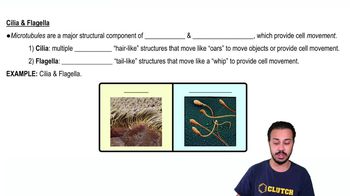
Recognize that flagella are long, whip-like structures that protrude from the cell body and are used by some protists for locomotion. They move in a wave-like manner to propel the organism through a liquid environment.
Identify that cilia are similar to flagella but are shorter and more numerous. They beat in a coordinated fashion to create movement, allowing some protists to swim.
Acknowledge that amoeboid motion requires energy in the form of ATP. This energy is used in the interaction between actin and myosin proteins, which are involved in the contraction and relaxation processes that enable the cell to move.
Evaluate each statement based on the understanding of these concepts: Amoeboid motion is not common in species with cell walls (False), some protists use flagella to swim (True), some protists use cilia to swim, which are shorter and more numerous than flagella (True), and amoeboid motion requires ATP and interactions between actin and myosin (True).

Risposta video verificata per un problema simile:

Questa soluzione video è stata consigliata dai nostri tutor come utile per risolvere questo problema.
Durata del video:
3m

Concetti chiave

Ecco i concetti essenziali che devi comprendere per rispondere correttamente alla domanda.

Amoeboid Motion

Amoeboid motion is a type of movement used by some protists, characterized by the extension of pseudopodia. This process involves the cytoskeleton, particularly actin and myosin proteins, and requires ATP for energy. Amoeboid motion is typically seen in protists without rigid cell walls, allowing for flexible shape changes.
Video consigliato:
04:07
Properties of Water- Thermal

Flagella

Flagella are long, whip-like structures that protrude from the cell body of certain protists, enabling them to swim. These appendages rotate or whip back and forth to propel the organism through liquid environments. Flagella are less numerous than cilia and are often used by protists for locomotion and feeding.
Video consigliato:
03:15
Cilia & Flagella

Cilia

Cilia are short, hair-like structures that cover the surface of some protists, facilitating movement and feeding. They beat in coordinated waves, allowing the organism to swim or move substances across its surface. Cilia are more numerous than flagella and provide efficient propulsion in aquatic environments.
Video consigliato:
03:15
Cilia & Flagella