Ch. 27 - Diversification of Eukaryotes
Freeman - Biological Science 8th Edition
Freeman8th EditionBiological ScienceISBN: 9780138276263Non è quello che usi tu?Cambia libro di testo
Capitolo 27, Problema 1

Why are protists considered paraphyletic?
a. They include many extinct forms, including lineages that no longer have any living representatives.
b. They include some but not all descendants of their most recent common ancestor.
c. They represent all of the descendants of a single common ancestor.
d. Not all protists have all of the synapomorphies that define the Eukarya, such as a nucleus.

Guida verificata passo dopo passo
1
Understand the definition of a paraphyletic group: A paraphyletic group consists of an ancestral species and some, but not all, of its descendants.
Identify the characteristics of protists: Protists are a diverse group of eukaryotic organisms that do not fit into the other kingdoms such as plants, animals, or fungi.
Analyze the options given: Consider which option describes a group that includes some but not all descendants of a common ancestor.
Option b states that protists include some but not all descendants of their most recent common ancestor, which aligns with the definition of a paraphyletic group.
Conclude that protists are considered paraphyletic because they do not include all descendants of their most recent common ancestor, as described in option b.

Risposta video verificata per un problema simile:

Questa soluzione video è stata consigliata dai nostri tutor come utile per risolvere questo problema.
Durata del video:
2m

Concetti chiave

Ecco i concetti essenziali che devi comprendere per rispondere correttamente alla domanda.

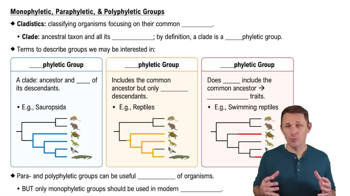
Paraphyletic Group

A paraphyletic group consists of organisms that include some, but not all, descendants of a common ancestor. This means that while they share a common lineage, the group excludes certain descendants that have diverged from the main lineage, making it incomplete in terms of evolutionary relationships.
Video consigliato:
Percorso guidato
06:37
Monophyletic, Paraphyletic, & Polyphyletic Group

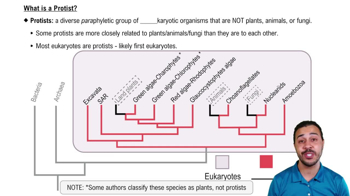
Protists

Protists are a diverse group of eukaryotic microorganisms, which are not classified as plants, animals, or fungi. They exhibit a wide range of characteristics and can be unicellular or multicellular. Due to their diversity and evolutionary history, protists do not form a monophyletic group, leading to their classification as paraphyletic.
Video consigliato:
03:23
What is a Protist?

Synapomorphies

Synapomorphies are shared derived traits that are used to determine evolutionary relationships among organisms. In the context of Eukarya, synapomorphies include features like a nucleus and membrane-bound organelles. Not all protists possess these defining traits, which contributes to their classification as paraphyletic within the broader eukaryotic lineage.
Video consigliato:
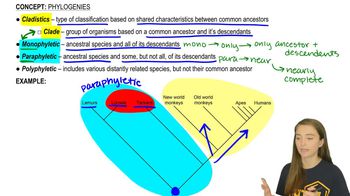
15:46
Cladistics