Ch. 30 - An Introduction to Animals
Freeman - Biological Science 8th Edition
Freeman8th EditionBiological ScienceISBN: 9780138276263Non è quello che usi tu?Cambia libro di testo
Capitolo 30, Problema 6

To estimate the relative abundance of the major phyla, calculate how many named species of arthropods, mollusks, and nematode worms exist per named species of chordate (the phylum containing vertebrates, including humans; see Table 30.1).
Do you think these calculations are likely to be underestimates or overestimates? Why?

Guida verificata passo dopo passo
1
Step 1: Identify the number of described species for each phylum mentioned in the problem. From Table 30.1, the number of described species is as follows: Arthropoda = 1,200,000, Mollusca = 85,000, Nematoda = 25,000, and Chordata = 65,000.
Step 2: Calculate the relative abundance of each phylum compared to Chordata. To do this, divide the number of described species for each phylum by the number of described species for Chordata. For example, for Arthropoda, the calculation would be: 120000065000.
Step 3: Repeat the calculation for Mollusca and Nematoda using the same formula: 8500065000 for Mollusca and 2500065000 for Nematoda.
Step 4: Interpret the results. The relative abundance values will indicate how many species of arthropods, mollusks, and nematodes exist per species of chordate. Larger values suggest higher diversity in those phyla compared to Chordata.
Step 5: Consider whether these calculations are likely to be underestimates or overestimates. Discuss factors such as undiscovered species, biases in research focus, and the difficulty of cataloging smaller or less conspicuous organisms, which may lead to underestimates of species numbers in certain phyla.

Risposta video verificata per un problema simile:

Questa soluzione video è stata consigliata dai nostri tutor come utile per risolvere questo problema.
Durata del video:
2m

Concetti chiave

Ecco i concetti essenziali che devi comprendere per rispondere correttamente alla domanda.

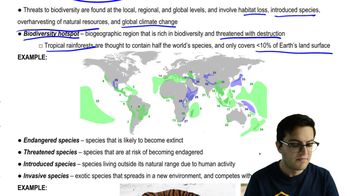
Biodiversity and Species Richness

Biodiversity refers to the variety of life in a particular habitat or ecosystem, encompassing the number of different species, their relative abundance, and the genetic diversity within those species. Species richness is a key component of biodiversity, indicating the total number of different species present in a given area. Understanding biodiversity is crucial for assessing ecological health and the impact of environmental changes.
Video consigliato:
04:32
Biodiversity Hotspots and Endangered Species

Phyla of Animals

In biological classification, a phylum is a higher taxonomic rank that groups together organisms sharing a basic structural framework. Major animal phyla include Arthropoda, Mollusca, and Chordata, each characterized by distinct anatomical and physiological traits. For instance, arthropods have exoskeletons and jointed limbs, while chordates possess a notochord at some stage of development, highlighting the diversity of life forms.
Video consigliato:
05:58
Overview of Animals - 1

Estimating Species Abundance

Estimating species abundance involves calculating the number of individuals of each species within a community, often expressed relative to a reference group. In this context, the calculation of arthropods, mollusks, and nematodes per chordate species helps to understand their relative abundance. Such estimates can be influenced by factors like sampling methods and ecological interactions, leading to potential underestimates or overestimates of true biodiversity.
Video consigliato:
Percorso guidato
03:24
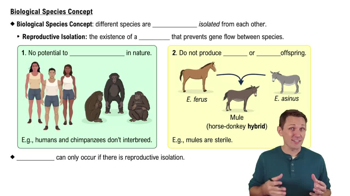
Biological Species Concept
Pratica correlata