Ch. 33 - Viruses
Freeman - Biological Science 8th Edition
Freeman8th EditionBiological ScienceISBN: 9780138276263Non è quello che usi tu?Cambia libro di testo
Capitolo 33, Problema 6

Compare and contrast the bacteriophage lytic cycle and lysogeny by addressing
(1) the rate of replication of the viral genome
(2) production of virions, and
(3) effect on the host cell.

Guida verificata passo dopo passo
1
Step 1: Begin by understanding the bacteriophage lytic cycle. In this cycle, the viral genome is rapidly replicated using the host cell's machinery. The bacteriophage hijacks the host's resources to produce multiple copies of its DNA or RNA.
Step 2: Contrast this with lysogeny, where the viral genome integrates into the host cell's genome as a prophage. During lysogeny, replication of the viral genome occurs passively as the host cell divides, meaning it is slower compared to the lytic cycle.
Step 3: Examine the production of virions. In the lytic cycle, the host cell's machinery is directed to produce new virions (complete virus particles), which are assembled and eventually released. In lysogeny, no virions are produced during the dormant phase, as the virus remains latent within the host genome.
Step 4: Analyze the effect on the host cell. In the lytic cycle, the host cell is destroyed (lysed) as the new virions are released, leading to cell death. In lysogeny, the host cell remains alive and continues to function normally, although it carries the integrated viral genome.
Step 5: Summarize the key differences: The lytic cycle is characterized by rapid replication, active production of virions, and destruction of the host cell, while lysogeny involves slower replication, no immediate virion production, and preservation of the host cell during the dormant phase.

Risposta video verificata per un problema simile:

Questa soluzione video è stata consigliata dai nostri tutor come utile per risolvere questo problema.
Durata del video:
2m

Concetti chiave

Ecco i concetti essenziali che devi comprendere per rispondere correttamente alla domanda.

Bacteriophage Lytic Cycle

The lytic cycle is a viral replication process where a bacteriophage infects a host bacterium, hijacks its cellular machinery to replicate its genome, and ultimately causes the host cell to lyse, releasing new virions. This cycle is characterized by rapid replication and high virion production, leading to immediate effects on the host cell, including cell death.
Video consigliato:
08:04
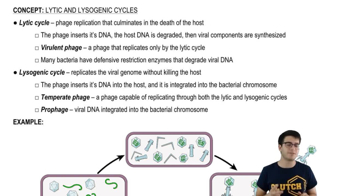
Lytic and Lysogenic Cycles

Lysogeny

Lysogeny is a viral life cycle in which the bacteriophage integrates its genome into the host bacterium's DNA, forming a prophage. This process allows the viral genome to be replicated along with the host's genome during cell division, resulting in a slower rate of replication and no immediate production of virions, which preserves the host cell's viability for an extended period.
Video consigliato:
08:04
Lytic and Lysogenic Cycles

Comparison of Effects on Host Cell

The lytic cycle leads to the destruction of the host cell through lysis, while lysogeny allows the host cell to survive and replicate, albeit with the viral genome incorporated. This difference in outcomes affects the host population dynamics, as lytic infections can lead to rapid declines in bacterial numbers, whereas lysogenic infections can contribute to genetic diversity and stability within bacterial populations.
Video consigliato:
05:33
Cell Junctions