
Ch. 40 - Water and Electrolyte Balance in Animals
Freeman - Biological Science 8th Edition
Freeman8th EditionBiological ScienceISBN: 9780138276263Non è quello che usi tu?Cambia libro di testo
Capitolo 40, Problema 5

Compare and contrast the types of nitrogenous wastes excreted by animals. Identify which type can be excreted with the least water, which is most toxic, and which waste is excreted by bony fishes, by mammals, and by insects. Which type would you expect to be produced by embryos inside eggs laid on land?

Guida verificata passo dopo passo
1
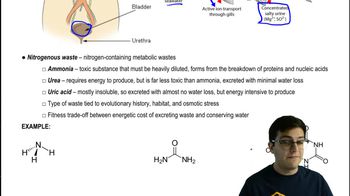
Step 1: Identify the three types of nitrogenous wastes excreted by animals: ammonia, urea, and uric acid.
Step 2: Compare and contrast these types. Ammonia is highly toxic and requires a lot of water to be excreted, making it suitable for aquatic animals. Urea is less toxic and requires less water, making it suitable for terrestrial animals like mammals. Uric acid is the least toxic and requires the least water, making it suitable for animals in dry environments like birds and insects.
Step 3: Identify which type of waste is excreted by each animal. Bony fishes excrete ammonia, mammals excrete urea, and insects excrete uric acid.
Step 4: Predict which type of waste would be produced by embryos inside eggs laid on land. Given the dry environment inside an egg, you would expect the embryo to produce uric acid, which requires the least water to excrete.
Step 5: Summarize your findings. Ammonia is the most toxic and requires the most water to excrete, making it suitable for aquatic animals like bony fishes. Urea is less toxic and requires less water, making it suitable for mammals. Uric acid is the least toxic and requires the least water, making it suitable for animals in dry environments like birds, insects, and embryos inside eggs laid on land.

Risposta video verificata per un problema simile:

Questa soluzione video è stata consigliata dai nostri tutor come utile per risolvere questo problema.
Durata del video:
1m

Concetti chiave

Ecco i concetti essenziali che devi comprendere per rispondere correttamente alla domanda.

Nitrogenous Wastes

Nitrogenous wastes are byproducts of protein metabolism and are primarily composed of nitrogen. The main types include ammonia, urea, and uric acid. Ammonia is highly toxic and requires a large amount of water for excretion, while urea is less toxic and can be excreted with moderate water loss. Uric acid is the least toxic and can be excreted with minimal water, making it advantageous for organisms in arid environments.
Video consigliato:
07:16
Osmoregulation and Nitrogenous Waste

Excretion in Different Animal Groups

Different animal groups excrete nitrogenous wastes in ways that reflect their evolutionary adaptations and habitats. Bony fishes primarily excrete ammonia directly into the water, where it is diluted. Mammals convert ammonia to urea for excretion, balancing toxicity and water conservation. Insects, on the other hand, excrete uric acid, which conserves water and is suitable for their terrestrial lifestyles.
Video consigliato:
04:03
Filtration, Reabsorption, and Excretion

Embryonic Development and Waste Excretion

Embryos that develop inside eggs laid on land typically produce uric acid as their nitrogenous waste. This adaptation is crucial for conserving water in a terrestrial environment, as uric acid is less toxic and can be stored in a solid form within the egg. This allows the developing embryo to thrive without the risk of accumulating toxic waste in a liquid medium, which would be detrimental in a confined space.
Video consigliato:
06:02
Embryonic Plant Development