
Ch. 40 - Water and Electrolyte Balance in Animals
Freeman - Biological Science 8th Edition
Freeman8th EditionBiological ScienceISBN: 9780138276263Non è quello che usi tu?Cambia libro di testo
Capitolo 40, Problema 2

Which of the following organisms would lose the most water by osmosis across its gills?
a. Marine bony fish
b. Shark
c. Freshwater fish
d. Freshwater invertebrate

Guida verificata passo dopo passo
1
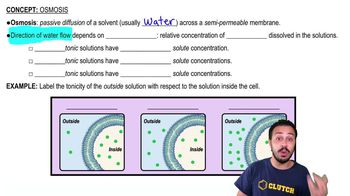
Understand the concept of osmosis: Osmosis is the movement of water across a semipermeable membrane from an area of lower solute concentration to an area of higher solute concentration.
Consider the environment of each organism: Marine organisms live in saltwater, which has a higher solute concentration than their body fluids, while freshwater organisms live in water with a lower solute concentration than their body fluids.
Analyze the marine bony fish: Marine bony fish are in a hypertonic environment, meaning the surrounding water has a higher solute concentration than their body fluids, leading to water loss by osmosis.
Analyze the shark: Sharks have a unique adaptation where they maintain a high concentration of urea in their body fluids, making them isotonic or slightly hypertonic to seawater, reducing water loss by osmosis.
Compare with freshwater organisms: Freshwater fish and invertebrates are in a hypotonic environment, meaning the surrounding water has a lower solute concentration than their body fluids, leading to water gain rather than loss by osmosis.

Risposta video verificata per un problema simile:

Questa soluzione video è stata consigliata dai nostri tutor come utile per risolvere questo problema.
Durata del video:
1m

Concetti chiave

Ecco i concetti essenziali che devi comprendere per rispondere correttamente alla domanda.

Osmosis

Osmosis is the movement of water across a semipermeable membrane from an area of lower solute concentration to an area of higher solute concentration. In aquatic organisms, osmosis affects how water is gained or lost through their gills, depending on the surrounding water's salinity.
Video consigliato:
05:59
Osmosis

Marine vs Freshwater Environments

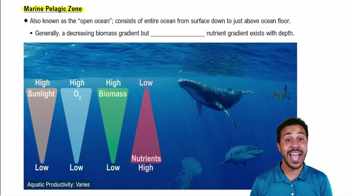
Marine environments have high salt concentrations, while freshwater environments have low salt concentrations. Organisms in these environments have adapted differently to regulate water and salt balance, influencing how they gain or lose water through osmosis.
Video consigliato:
02:14
Marine Pelagic Zone

Adaptations in Aquatic Organisms

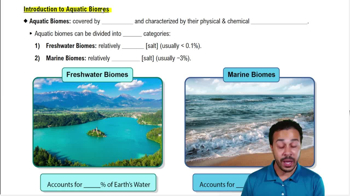
Aquatic organisms have developed physiological adaptations to manage osmoregulation. Marine bony fish, for example, tend to lose water due to the high salinity of their environment, while freshwater organisms gain water due to the lower external solute concentration.
Video consigliato:
01:38
Introduction to Aquatic Biomes
Pratica correlata
Domanda del libro di testo

What effect does antidiuretic hormone (ADH) have on the nephron?

a. It increases the water permeability of the descending limb of the loop of Henle.

b. It decreases the water permeability of the descending limb of the loop of Henle.

c. It increases the water permeability of the collecting duct.

d. It decreases the water permeability of the collecting duct.

3200
views
Domanda del libro di testo

In Gila monsters, the organ in which water from urine is reabsorbed into the bloodstream is the___________.             .

537
views
Domanda del libro di testo

Which of the following statements regarding fishes that live in fresh-water is/are correct? Select True or False for each statement.

T/F Water moves across the gills via osmosis until equilibrium is established, at which time the water molecules stop moving.

T/F They lose water to their environment primarily through the gills. They replace this water by drinking.

T/F Water enters epithelial cells in their gills via osmosis. Electrolytes leave the same cells via diffusion.

T/F They have specialized epithelia that actively pump electrolytes from the environment into the blood.

533
views
Domanda del libro di testo

Compare and contrast the types of nitrogenous wastes excreted by animals. Identify which type can be excreted with the least water, which is most toxic, and which waste is excreted by bony fishes, by mammals, and by insects. Which type would you expect to be produced by embryos inside eggs laid on land?

1493
views