Ch. 47 - Animal Reproduction and Development
Freeman - Biological Science 8th Edition
Freeman8th EditionBiological ScienceISBN: 9780138276263Non è quello che usi tu?Cambia libro di testo
Capitolo 47, Problema 3

Which of the following statements regarding animal development is/are correct? Select True or False for each statement.
T/FThe neural tube forms after organogenesis is complete
T/FThe blastocyst is formed during cleavage
T/FDuring cleavage, the zygote divides rapidly without growth, forming a mass of cells
T/FAnimals have two germ layers

Guida verificata passo dopo passo
1
Understand the sequence of animal development stages: fertilization, cleavage, blastula formation, gastrulation, and organogenesis.
Evaluate the statement about the neural tube: The neural tube forms during neurulation, which occurs after gastrulation but before organogenesis is complete.
Consider the formation of the blastocyst: The blastocyst is formed during the cleavage stage, which is characterized by rapid cell division without growth.
Analyze the process of cleavage: During cleavage, the zygote undergoes rapid mitotic divisions, resulting in a multicellular structure without an increase in overall size.
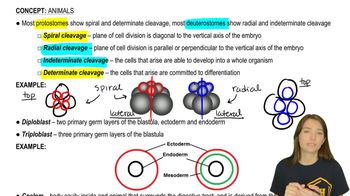
Review the concept of germ layers: Most animals develop three primary germ layers (ectoderm, mesoderm, and endoderm) during gastrulation, not two.

Risposta video verificata per un problema simile:

Questa soluzione video è stata consigliata dai nostri tutor come utile per risolvere questo problema.
Durata del video:
1m

Concetti chiave

Ecco i concetti essenziali che devi comprendere per rispondere correttamente alla domanda.

Neural Tube Formation

The neural tube is a key structure in the early development of the nervous system in vertebrates. It forms during neurulation, which occurs after the initial stages of organogenesis. The neural tube eventually develops into the brain and spinal cord, highlighting its importance in embryonic development.
Video consigliato:
03:08
Formation & Breakdown of Polysaccharides

Blastocyst Formation

The blastocyst is an early stage in mammalian embryonic development, formed during the cleavage phase. Cleavage involves rapid cell division without growth, resulting in a multicellular structure. The blastocyst consists of an inner cell mass, which will become the embryo, and an outer layer called the trophoblast, which contributes to placenta formation.
Video consigliato:
03:08
Formation & Breakdown of Polysaccharides

Germ Layers in Animals

Germ layers are fundamental layers of cells formed during embryogenesis that give rise to all tissues and organs. Most animals, including humans, have three germ layers: ectoderm, mesoderm, and endoderm. However, some simpler animals, like cnidarians, have only two germ layers, ectoderm and endoderm, which are crucial for their basic body structures.
Video consigliato:
12:01
Overview of Animals - 3