Ch. 5 - An Introduction to Carbohydrates
Freeman - Biological Science 8th Edition
Freeman8th EditionBiological ScienceISBN: 9780138276263Non è quello che usi tu?Cambia libro di testo
Capitolo 5, Problema 7

Contrast the structure of glycogen and chitin in terms of their monosaccharides, glycosidic linkages, and interactions between polysaccharide chains.

Guida verificata passo dopo passo
1
Step 1: Identify the monosaccharides that make up each polysaccharide. Glycogen is a polysaccharide of glucose, a monosaccharide. Chitin, on the other hand, is a polysaccharide of N-acetylglucosamine, a derivative of glucose.
Step 2: Understand the glycosidic linkages in each polysaccharide. Glycogen has α-1,4-glycosidic linkages and α-1,6-glycosidic linkages at the branch points. Chitin has β-1,4-glycosidic linkages.
Step 3: Analyze the interactions between polysaccharide chains. In glycogen, the glucose units are oriented in a way that allows the molecule to be highly branched, which facilitates rapid glucose release. In chitin, the N-acetylglucosamine units form extended fibers that are cross-linked by hydrogen bonds, providing strength and rigidity.
Step 4: Summarize the differences. Glycogen, made of glucose, has α-1,4 and α-1,6 linkages and is highly branched, allowing for rapid glucose release. Chitin, made of N-acetylglucosamine, has β-1,4 linkages and forms extended fibers that are cross-linked by hydrogen bonds, providing strength and rigidity.
Step 5: Remember the biological roles of these polysaccharides. Glycogen serves as a form of energy storage in animals and fungi, while chitin is a structural component in the exoskeletons of arthropods and the cell walls of fungi.

Risposta video verificata per un problema simile:

Questa soluzione video è stata consigliata dai nostri tutor come utile per risolvere questo problema.
Durata del video:
2m

Concetti chiave

Ecco i concetti essenziali che devi comprendere per rispondere correttamente alla domanda.

Monosaccharide Composition

Glycogen and chitin are both polysaccharides, but they differ in their monosaccharide units. Glycogen is primarily composed of glucose units, which are a type of hexose sugar. In contrast, chitin is made up of N-acetylglucosamine, a derivative of glucose that contains an acetamido group. This difference in monosaccharide composition significantly influences their structural properties and biological functions.
Video consigliato:
06:13
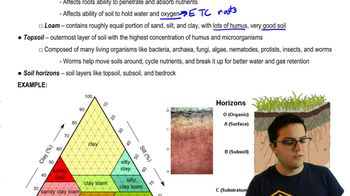
Soil Composition

Glycosidic Linkages

The glycosidic linkages in glycogen and chitin also differ, affecting their structural characteristics. Glycogen features α(1→4) linkages between glucose units, with occasional α(1→6) branches, allowing for a highly branched structure that facilitates rapid energy release. Chitin, on the other hand, has β(1→4) linkages between N-acetylglucosamine units, resulting in a more linear and rigid structure, which contributes to its role in providing strength and protection in exoskeletons.
Video consigliato:
03:08
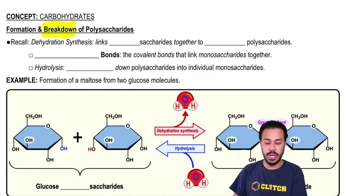
Formation & Breakdown of Polysaccharides

Polysaccharide Chain Interactions

The interactions between polysaccharide chains in glycogen and chitin are crucial for their respective functions. In glycogen, the branching structure allows for efficient storage and mobilization of glucose, as multiple enzymes can act simultaneously on different branches. Conversely, chitin's linear chains can form extensive hydrogen bonds and crystalline structures, providing mechanical strength and resistance to degradation, which is essential for its role in the structural integrity of organisms like insects and fungi.
Video consigliato:
03:08
Formation & Breakdown of Polysaccharides
Pratica correlata
Domanda del libro di testo

If you hold a salty cracker in your mouth long enough, it will begin to taste sweet. What is responsible for this change in taste?

2094
views
Domanda del libro di testo

Galactosemia is a potentially fatal disease that occurs in humans who lack the enzyme that converts galactose to glucose. If you were a physician treating a person with this disease, which of the following would you have them exclude from their diet?

a. Maltose

b. Starch

c. Mannose

d. Lactose

2540
views
Domanda del libro di testo

What are the primary functions of carbohydrates in cells?

a. Cell identity, energy storage, raw material source for synthesis, and structure

b. Catalysis, energy storage, metabolism, and structure

c. Catalysis, digestion, energy storage, and information storage

d. Energy storage, information storage, polymerization, and raw material source for synthesis

3437
views
Domanda del libro di testo

Lysozyme, an enzyme found in human saliva, tears, and other secretions, catalyzes the hydrolysis of the β-1,4-glycosidic linkages in peptidoglycan. Predict the effect of this enzyme on bacteria and how it may be involved in human health.

3251
views
Domanda del libro di testo

Which of the differences listed here could be found among molecules of the same monosaccharide? Select True or False for each statement.

T/F There is a difference in the orientation of a hydroxyl group in the ring form.

T/F There is a difference in the number of carbons.

T/F There is a difference in the position of the carbonyl group in the linear form.

T/F There is a difference in the overall shape of the molecule—one is a ring and the other is linear.

1853
views
Domanda del libro di testo

Although cellulose and starch are identical in terms of stored chemical energy, our ability to harvest the energy from these two polysaccharides differs considerably. What is responsible for this difference?

2381
views