

Ch. 5 - An Introduction to Carbohydrates
Freeman - Biological Science 8th Edition
Freeman8th EditionBiological ScienceISBN: 9780138276263Non è quello che usi tu?Cambia libro di testo
Capitolo 5, Problema 10

If you hold a salty cracker in your mouth long enough, it will begin to taste sweet. What is responsible for this change in taste?

Guida verificata passo dopo passo
1
Step 1: Understand the question. The question is asking why a salty cracker begins to taste sweet if it's held in the mouth for a long time.
Step 2: Recall the process of digestion. Digestion begins in the mouth where food is broken down into simpler forms. The enzyme responsible for this in the mouth is called amylase.
Step 3: Understand the role of amylase. Amylase breaks down complex carbohydrates (like those found in crackers) into simpler sugars. This process is called hydrolysis.
Step 4: Apply this knowledge to the question. As the cracker is held in the mouth, amylase continues to break down the carbohydrates into sugars. This is why the cracker begins to taste sweet after a while.
Step 5: Formulate the answer. The change in taste from salty to sweet when a cracker is held in the mouth for a long time is due to the action of the enzyme amylase, which breaks down the carbohydrates in the cracker into simpler sugars.

Risposta video verificata per un problema simile:

Questa soluzione video è stata consigliata dai nostri tutor come utile per risolvere questo problema.
Durata del video:
1m

Concetti chiave

Ecco i concetti essenziali che devi comprendere per rispondere correttamente alla domanda.

Taste Perception

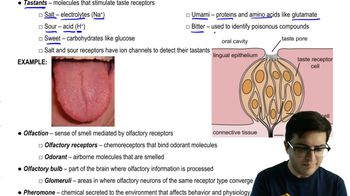
Taste perception involves the sensory experience of flavor through taste buds on the tongue. These taste buds detect five primary tastes: sweet, sour, salty, bitter, and umami. The brain interprets signals from these receptors, allowing us to perceive different flavors based on the chemical composition of the food.
Video consigliato:
04:46
Smell and Taste

Saliva and Enzymatic Action

Saliva plays a crucial role in taste perception by dissolving food particles, which allows taste receptors to interact with the chemicals in the food. Saliva contains enzymes, such as amylase, that begin the breakdown of carbohydrates, potentially altering the flavor profile of the food as it is processed in the mouth.
Video consigliato:
09:55
Action Potential

Flavor Change Over Time

The phenomenon of a salty cracker tasting sweet over time can be attributed to the prolonged exposure of the cracker to saliva, which alters its chemical composition. As the starches in the cracker are broken down into simpler sugars by salivary enzymes, the initial salty flavor diminishes, allowing the sweetness to emerge more prominently.
Video consigliato:
03:36
Pollution and Climate Change