
Ch. 6 - Lipids, Membranes, and the First Cells
Freeman - Biological Science 8th Edition
Freeman8th EditionBiological ScienceISBN: 9780138276263Non è quello che usi tu?Cambia libro di testo
Capitolo 6, Problema 10

Examine the experimental chamber in Figure 6.8a. Explain what would occur by osmosis if you added a 1-M solution of sodium chloride on the left side and an equal volume of a 1.5 M solution of potassium ions on the right. How might the addition of the CFTR protein to the lipid bilayer impact the direction of water movement?

Guida verificata passo dopo passo
1
Identify the initial conditions: 1-M NaCl on the left side and 1.5-M K+ on the right side.
Understand osmosis: Water moves from areas of low solute concentration to high solute concentration.
Predict water movement: Water will move from the left side (lower solute concentration) to the right side (higher solute concentration).
Consider the role of CFTR protein: CFTR facilitates the movement of chloride ions across the membrane.
Impact of CFTR: If CFTR is added, chloride ions may move, potentially altering the osmotic balance and affecting water movement.

Risposta video verificata per un problema simile:

Questa soluzione video è stata consigliata dai nostri tutor come utile per risolvere questo problema.
Durata del video:
2m

Concetti chiave

Ecco i concetti essenziali che devi comprendere per rispondere correttamente alla domanda.

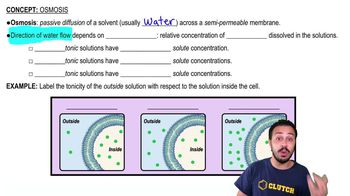
Osmosis

Osmosis is the movement of water across a selectively permeable membrane from an area of lower solute concentration to an area of higher solute concentration. This process aims to equalize solute concentrations on both sides of the membrane. In the context of the question, adding a 1-M sodium chloride solution on one side and a 1.5 M potassium ion solution on the other creates a concentration gradient that drives water movement toward the higher solute concentration.
Video consigliato:
05:59
Osmosis

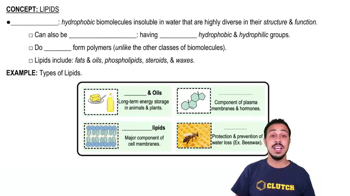
Lipid Bilayer

A lipid bilayer is a fundamental component of cell membranes, consisting of two layers of phospholipids arranged tail-to-tail. This structure creates a hydrophobic core that is impermeable to most water-soluble substances, allowing selective permeability. In the experimental setup, the lipid bilayer separates the two solutions, influencing the direction of water movement based on osmotic gradients and the presence of solutes.
Video consigliato:
04:19
Lipids

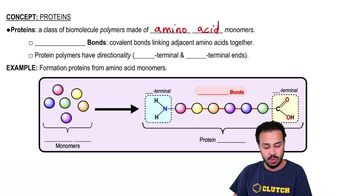
CFTR Protein

The Cystic Fibrosis Transmembrane Conductance Regulator (CFTR) protein is a channel protein that facilitates the transport of chloride ions across epithelial cell membranes. Its presence in the lipid bilayer can alter osmotic balance by allowing chloride ions to move, which can subsequently affect water movement due to osmotic pressure changes. The addition of CFTR could enhance water flow toward the side with higher ion concentration, impacting the overall osmotic dynamics.
Video consigliato:
02:50
Proteins