Ch. 6 - Lipids, Membranes, and the First Cells
Freeman - Biological Science 8th Edition
Freeman8th EditionBiological ScienceISBN: 9780138276263Non è quello che usi tu?Cambia libro di testo
Capitolo 6, Problema 7

In terms of structure, how do channel proteins differ from carrier proteins?

Guida verificata passo dopo passo
1
Step 1: Understand the basic function of proteins. Proteins are large, complex molecules that play many critical roles in the body. They do most of the work in cells and are required for the structure, function, and regulation of the body's tissues and organs.
Step 2: Define channel proteins. Channel proteins are integral membrane proteins that form a channel to allow specific molecules or ions to pass through the cell membrane. They have a hydrophilic channel that certain molecules or atomic ions use as a tunnel through the membrane.
Step 3: Define carrier proteins. Carrier proteins are integral membrane proteins that bind to a specific molecule, change shape, and flip the molecule across the membrane. They are involved in the facilitated diffusion and active transport of molecules across the cell membrane.
Step 4: Compare the structures. Channel proteins have a pore for molecules to pass through, while carrier proteins do not have a pore but change shape to transport molecules across the membrane.
Step 5: Summarize the differences. In terms of structure, channel proteins form a tunnel that allows molecules to simply pass through, while carrier proteins bind to a molecule and change shape to shuttle them across the membrane.

Risposta video verificata per un problema simile:

Questa soluzione video è stata consigliata dai nostri tutor come utile per risolvere questo problema.
Durata del video:
1m

Concetti chiave

Ecco i concetti essenziali che devi comprendere per rispondere correttamente alla domanda.

Channel Proteins

Channel proteins are integral membrane proteins that form pores or channels in the cell membrane, allowing specific ions or molecules to pass through by diffusion. They are typically selective, meaning they only permit certain substances to enter or exit the cell based on size and charge. This process is passive and does not require energy, making channel proteins crucial for maintaining cellular homeostasis.
Video consigliato:
02:50
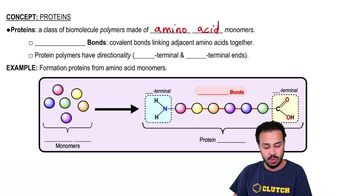
Proteins

Carrier Proteins

Carrier proteins, unlike channel proteins, bind to specific molecules and undergo a conformational change to transport these substances across the cell membrane. This process can be passive (facilitated diffusion) or active, requiring energy input to move substances against their concentration gradient. Carrier proteins are essential for the uptake of nutrients and the removal of waste products from the cell.
Video consigliato:
02:50
Proteins

Membrane Transport Mechanisms

Membrane transport mechanisms refer to the various ways substances move across the cell membrane, including passive transport (like diffusion and facilitated diffusion) and active transport. Understanding these mechanisms is vital for distinguishing how channel and carrier proteins function, as they represent two different strategies for regulating the internal environment of the cell and responding to changes in external conditions.
Video consigliato:
02:47
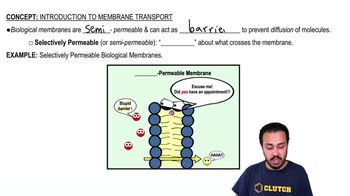
Introduction to Membrane Transport
Pratica correlata
Domanda del libro di testo

Draw and label the plasma membrane of a cell that is placed in a solution with concentrations of calcium ions and lactose that are greater than those on the inside of the cell. Use arrows to show the relevant gradients and the activity of the following membrane proteins:

(1) A pump that exports protons

(2) A calcium channel

(3) A lactose carrier

2956
views
Domanda del libro di testo

Examine the experimental chamber in Figure 6.8a. Explain what would occur by osmosis if you added a 1-M solution of sodium chloride on the left side and an equal volume of a 1.5 M solution of potassium ions on the right. How might the addition of the CFTR protein to the lipid bilayer impact the direction of water movement?

2249
views
Domanda del libro di testo

Which of the following groups of amino acid residues would likely be found in the portion that crosses the lipid bilayer?

a. Acidic

b. Basic

c. Polar uncharged

d. Nonpolar

2335
views
Domanda del libro di testo

Suppose a cell is placed in a solution with a high concentration of potassium and no sodium. How would the cellular sodium–potassium pump function in this environment?

a. It would stop moving ions across the membrane.

b. It would continue using ATP to pump sodium out of the cell and potassium into the cell.

c. It would move sodium and potassium ions across the membrane, but no ATP would be used.

d. It would reverse the direction of sodium and potassium ions to move them against their gradients.

2446
views
Domanda del libro di testo

Cooking oil lipids consist of long, unsaturated hydrocarbon chains. Would you expect these molecules to form membranes spontaneously? Why or why not? Describe, on a molecular level, how you would expect these lipids to behave in water.

2317
views
Domanda del libro di testo

In an experiment, you create two groups of liposomes in a solution containing 0.1 M NaCl—one made from red blood cell membranes and the other from frog egg cell membranes. When the liposomes are placed in water, those with red blood cell membranes burst more rapidly than those made from egg membranes. What could explain these results? Select True or False for each of the following statements.

a. T/F The red blood cell liposomes are more hypertonic relative to water than the frog egg liposomes.

b. T/F The red blood cell liposomes are more hypotonic relative to water than the frog egg liposomes.

c. T/F The red blood cell liposomes contain more aquaporins than the frog egg liposomes.

d. T/F The frog egg liposomes contain ion channels, which are not present in the red blood cell liposomes.

2236
views