Ch. 7 - Inside the Cell
Freeman - Biological Science 8th Edition
Freeman8th EditionBiological ScienceISBN: 9780138276263Non è quello che usi tu?Cambia libro di testo
Capitolo 7, Problema 5

Which of the following cell structures would you expect to be most important in the growth of bacteria on the surface of your teeth?
a. Cell wall
b. Fimbriae
c. Flagella
d. Cilia

Guida verificata passo dopo passo
1
Understand the function of each cell structure option provided: cell wall, fimbriae, flagella, and cilia.
Cell walls provide structural support and protection, but are not directly involved in attachment to surfaces.
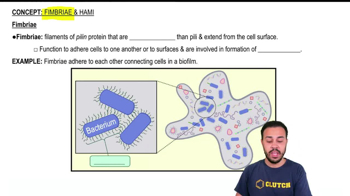
Fimbriae are hair-like structures that allow bacteria to adhere to surfaces, which is crucial for growth on teeth.
Flagella are tail-like structures used for movement, not attachment, so they are less relevant for bacteria adhering to teeth.
Cilia are similar to flagella but are typically found in eukaryotic cells, not bacteria, and are used for movement rather than attachment.

Risposta video verificata per un problema simile:

Questa soluzione video è stata consigliata dai nostri tutor come utile per risolvere questo problema.
Durata del video:
2m

Concetti chiave

Ecco i concetti essenziali che devi comprendere per rispondere correttamente alla domanda.

Fimbriae

Fimbriae are hair-like appendages on the surface of bacterial cells that enable them to adhere to surfaces, such as the enamel of teeth. This adhesion is crucial for bacteria to colonize and form biofilms, which are communities of bacteria that contribute to dental plaque formation. Understanding fimbriae is essential for recognizing how bacteria establish themselves in the oral cavity.
Video consigliato:
01:52
Fimbriae

Biofilm Formation

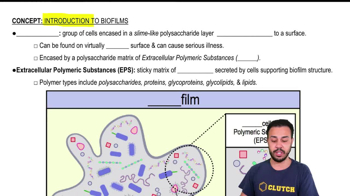
Biofilms are structured communities of bacteria that attach to surfaces and are embedded in a self-produced extracellular matrix. In the context of dental health, biofilms on teeth can lead to plaque formation, which is a precursor to cavities and gum disease. The ability of bacteria to form biofilms is a key factor in their growth and persistence on teeth surfaces.
Video consigliato:
03:31
Introduction to Biofilms

Bacterial Adhesion

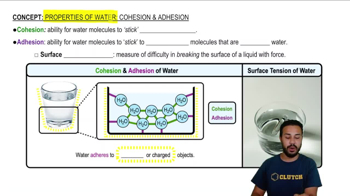
Bacterial adhesion is the process by which bacteria attach to surfaces, a critical step in colonization and biofilm formation. This process often involves specific structures like fimbriae, which facilitate the initial attachment to surfaces such as teeth. Understanding bacterial adhesion helps explain how bacteria can persist in the oral environment and contribute to dental issues.
Video consigliato:
04:16
Properties of Water- Cohesion and Adhesion
Pratica correlata
Domanda del libro di testo

How does the hydrolysis of ATP result in the movement of a motor protein along a cytoskeletal filament?

2076
views

Domanda del libro di testo

Most of the proteins that enter the nucleus possess a nuclear localization signal (NLS), even if they are small enough to pass through the nuclear pore complex unhindered. Why would a small protein have an NLS, when it naturally diffuses across the nuclear pore complex without one?

2435
views
Domanda del libro di testo

The eukaryotic cytoskeleton is a highly dynamic network of filaments and motor proteins. Which of the following correctly describe activities of these cytoskeletal components? Select True or False for each statement.

T/FMyosin motors walk toward the plus ends of intermediate filaments.

T/FDynein motors are responsible for the whip-like movement of eukaryotic flagella.

T/FKinesin motors move vesicles along tracks toward the microtubule-organizing center.

T/FActin filaments are required for cytoplasmic streaming.

2037
views
Domanda del libro di testo

Molecular zip codes direct molecules to particular destinations in the cell. How are these signals read?

a. They bind to receptor proteins.

b. They enter transport vesicles.

c. They bind to motor proteins.

d. They are glycosylated by enzymes.

2200
views
Domanda del libro di testo

Cells that line your intestines are known to possess a large number of membrane proteins that transport small molecules and ions across the plasma membrane. Which of the following cell structures would you expect to be required for this characteristic of the cells?

a. The endoplasmic reticulum

b. Peroxisomes

c. Lysosomes

d. The cell wall

1872
views
Domanda del libro di testo

Which of the following results provided evidence of a discrete nuclear localization signal somewhere on the nucleoplasmin protein?

a. The nucleoplasmin protein was small and easily slipped through the nuclear pore complex.

b. After cleavage of the nucleoplasmin protein, only the tail segments appeared in the nucleus.

c. Removing the tail from the nucleoplasmin protein allowed the core segment to enter the nucleus.

d. The SRP bound only to the tail of the nucleoplasmin protein, not the core segment.

1870
views