
Ch. 8 - Energy and Enzymes: An Introduction to Metabolism
Freeman - Biological Science 8th Edition
Freeman8th EditionBiological ScienceISBN: 9780138276263Non è quello che usi tu?Cambia libro di testo
Capitolo 8, Problema 5

Explain the lock-and-key model of enzyme activity. What is incorrect about this model?

Guida verificata passo dopo passo
1
The lock-and-key model of enzyme activity is a theory that explains how enzymes and substrates interact. According to this model, the active site of an enzyme, where the substrate binds, is a perfect fit for the substrate, much like a key fits into a lock. The substrate, or 'key', fits into the enzyme, or 'lock', triggering a chemical reaction that forms a product.
The lock-and-key model suggests that the enzyme's active site is rigid and does not change shape. However, this is not entirely accurate. In reality, the active site of an enzyme can change shape to better fit the substrate, a concept known as induced fit. This means that while the lock-and-key model provides a basic understanding of enzyme activity, it oversimplifies the dynamic nature of enzyme-substrate interactions.
The induced fit model suggests that the active site of an enzyme is flexible and can adapt to fit the substrate. When the substrate enters the active site, it induces a change in the enzyme's shape, improving the fit and facilitating the chemical reaction.
Another limitation of the lock-and-key model is that it does not account for the role of water in enzyme activity. Many enzymes require a water molecule to function, which is not represented in the lock-and-key model.
Despite its limitations, the lock-and-key model is still useful for introducing the concept of enzyme activity and providing a basic understanding of how enzymes work. However, for a more accurate representation of enzyme activity, the induced fit model is generally preferred.

Risposta video verificata per un problema simile:

Questa soluzione video è stata consigliata dai nostri tutor come utile per risolvere questo problema.
Durata del video:
3m

Concetti chiave

Ecco i concetti essenziali che devi comprendere per rispondere correttamente alla domanda.

Lock-and-Key Model

The lock-and-key model is a theory that describes how enzymes interact with substrates. According to this model, the enzyme (the 'lock') has a specific shape that perfectly fits the substrate (the 'key'). This specificity allows the enzyme to catalyze a reaction by forming an enzyme-substrate complex, leading to the conversion of substrates into products.
Video consigliato:
01:09
Introduction to Population Growth Models

Enzyme-Substrate Complex

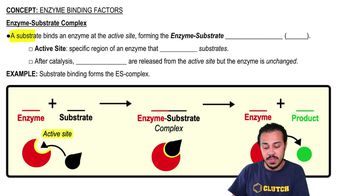
The enzyme-substrate complex is a temporary molecular structure formed when a substrate binds to the active site of an enzyme. This complex is crucial for the catalytic process, as it stabilizes the transition state and lowers the activation energy required for the reaction to proceed. Understanding this complex is essential for grasping how enzymes facilitate biochemical reactions.
Video consigliato:
03:49
Enzyme-Substrate Complex

Induced Fit Model

The induced fit model is an alternative to the lock-and-key model, suggesting that the active site of an enzyme is flexible and can change shape to better fit the substrate upon binding. This model accounts for the dynamic nature of enzyme-substrate interactions and explains how enzymes can accommodate various substrates, enhancing their catalytic efficiency and specificity.
Video consigliato:
01:09
Introduction to Population Growth Models
Pratica correlata
Domanda del libro di testo

Using what you have learned about changes in Gibbs free energy, would you predict the ∆G value of catabolic reactions to be positive or negative? What about anabolic reactions? Justify your answers using the terms 'enthalpy' and 'entropy.'

2553
views
Domanda del libro di testo

If you were to expose glucose to oxygen on your lab bench, why would you not expect to see it burn as described by the reaction in Figure 8.6?

a. The reaction is endergonic and requires an input of energy.

b. The reaction is not spontaneous unless an enzyme is added.

c. The sugar must first be phosphorylated to increase its potential energy.

d. Activation energy is required for the sugar and oxygen to reach their transition state.

1951
views
Domanda del libro di testo

In Figure 8.10, the energetic coupling of substrate phosphorylation and an endergonic reaction are shown. If the hydrolysis of ATP releases 7.3 kcal of free energy, use the graph in this figure to estimate what you would expect the ∆G values to be for the uncoupled reaction and the two steps in the coupled reaction.


2471
views
Domanda del libro di testo

Explain how feedback inhibition regulates metabolic pathways.

1535
views
Domanda del libro di testo

What is a transition state?

a. The shape adopted by an enzyme that has an inhibitory molecule bound at its active site

b. The amount of kinetic energy required for a reaction to proceed

c. The intermediate complex formed as covalent bonds in the reactants are being broken and re-formed during a reaction

d. The enzyme shape after binding an allosteric regulatory molecule

2503
views
Domanda del libro di testo

How does pH affect enzyme-catalyzed reactions?

a. Protons serve as substrates for most reactions.

b. Energy stored in protons is used to drive endergonic reactions.

c. Proton concentration increases the kinetic energy of the reactants, enabling them to reach their transition state.

d. The concentration of protons affects an enzyme's folded structure and reactivity.

2419
views