Ch. 8 - Energy and Enzymes: An Introduction to Metabolism
Freeman - Biological Science 8th Edition
Freeman8th EditionBiological ScienceISBN: 9780138276263Non è quello che usi tu?Cambia libro di testo
Capitolo 8, Problema 8

Using what you have learned about changes in Gibbs free energy, would you predict the ∆G value of catabolic reactions to be positive or negative? What about anabolic reactions? Justify your answers using the terms 'enthalpy' and 'entropy.'

Guida verificata passo dopo passo
1
Begin by understanding Gibbs free energy (∆G), which is a measure of the spontaneity of a reaction. A negative ∆G indicates a spontaneous reaction, while a positive ∆G indicates a non-spontaneous reaction.
Recall that catabolic reactions involve the breakdown of complex molecules into simpler ones, releasing energy in the process. This release of energy typically results in a negative ∆G value, indicating that these reactions are spontaneous.
Consider the role of enthalpy (∆H) in catabolic reactions. These reactions often release heat, leading to a decrease in enthalpy. A decrease in enthalpy contributes to a negative ∆G value.
Examine the concept of entropy (∆S), which is a measure of disorder. Catabolic reactions increase entropy as they break down complex molecules into simpler ones, contributing to a negative ∆G value.
Analyze anabolic reactions, which involve the synthesis of complex molecules from simpler ones, requiring an input of energy. This energy input typically results in a positive ∆G value, indicating that these reactions are non-spontaneous. Anabolic reactions often involve an increase in enthalpy and a decrease in entropy, both contributing to a positive ∆G value.

Risposta video verificata per un problema simile:

Questa soluzione video è stata consigliata dai nostri tutor come utile per risolvere questo problema.
Durata del video:
4m

Concetti chiave

Ecco i concetti essenziali che devi comprendere per rispondere correttamente alla domanda.

Gibbs Free Energy (∆G)

Gibbs Free Energy (∆G) is a thermodynamic quantity that indicates the amount of energy available to do work in a system at constant temperature and pressure. A negative ∆G indicates a spontaneous process, while a positive ∆G suggests a non-spontaneous process. It is calculated using the equation ∆G = ∆H - T∆S, where ∆H is the change in enthalpy, T is the temperature, and ∆S is the change in entropy.
Video consigliato:
04:58
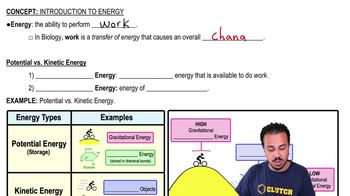
Introduction to Energy

Catabolic Reactions

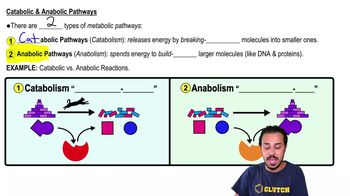
Catabolic reactions involve the breakdown of complex molecules into simpler ones, releasing energy in the process. These reactions typically have a negative ∆G, indicating they are spontaneous. The breakdown of molecules increases entropy (∆S) and often releases heat, resulting in a decrease in enthalpy (∆H), both contributing to a negative ∆G.
Video consigliato:
03:25
Catabolic & Anabolic Pathways

Anabolic Reactions

Anabolic reactions are processes that build complex molecules from simpler ones, requiring an input of energy. These reactions usually have a positive ∆G, meaning they are non-spontaneous and require energy input. Anabolic processes decrease entropy (∆S) as they create order, and they often involve an increase in enthalpy (∆H) due to the energy required to form new bonds.
Video consigliato:
03:25
Catabolic & Anabolic Pathways
Pratica correlata
Domanda del libro di testo

You have discovered an enzyme that appears to function only when a particular sugar accumulates. Which of the following scenarios would you predict to be responsible for activating this enzyme?

a. The sugar cleaves the enzyme to form the active conformation.

b. The sugar is an allosteric regulatory molecule for the enzyme.

c. The sugar is a competitive inhibitor for the enzyme.

d. The sugar phosphorylates the enzyme to form the active conformation.

2262
views
Domanda del libro di testo

If you were to expose glucose to oxygen on your lab bench, why would you not expect to see it burn as described by the reaction in Figure 8.6?

a. The reaction is endergonic and requires an input of energy.

b. The reaction is not spontaneous unless an enzyme is added.

c. The sugar must first be phosphorylated to increase its potential energy.

d. Activation energy is required for the sugar and oxygen to reach their transition state.

1949
views
Domanda del libro di testo

In Figure 8.10, the energetic coupling of substrate phosphorylation and an endergonic reaction are shown. If the hydrolysis of ATP releases 7.3 kcal of free energy, use the graph in this figure to estimate what you would expect the ∆G values to be for the uncoupled reaction and the two steps in the coupled reaction.


2471
views
Domanda del libro di testo

Explain the lock-and-key model of enzyme activity. What is incorrect about this model?

2800
views
Domanda del libro di testo

Draw a chemical equation to represent the redox reaction that occurs when methane (CH4) burns in the presence of oxygen (O2). Identify the reactant that is reduced and the reactant that is oxidized. Of the four molecules that should be in your equation, point out the one that has bonds with the highest potential energy.

2964
views
1
rank