Indietro
Business Calculus Study Notes: Limits, Continuity, and the Derivative
Guida di studio - Note intelligenti
 Appunti personalizzati basati sui tuoi materiali, ampliati con definizioni chiave, esempi e contesto.
Limits and Continuity
Limit Notation and Definition
The concept of a limit is fundamental in calculus and describes the behavior of a function as its input approaches a particular value. The notation for the limit of a function f(x) as x approaches a is:
Definition: means that as x gets arbitrarily close to a, f(x) gets arbitrarily close to L.
Example:
Limits of Piecewise Functions
Piecewise functions may have different expressions for different intervals. To find the limit at a point, consider the function's behavior from both sides.
Example: For defined differently for and , evaluate the limit from the left and right at .
Properties of Limits
Several properties simplify the calculation of limits:
Limit of a Constant:
Limit of a Polynomial:
Limit of a Rational Function: if
Limit of a Sum/Difference:
Limit of a Product:
Limit of a Quotient: if
Limit of a Power:
Limit of a Radical:
Limits Involving Infinity
Limits as x approaches infinity often depend on the degree of the numerator and denominator in rational functions.
Property: (for )
Property: (for )
Dominant Term Property: For polynomials, the highest degree term dominates as .
Cases:
Degree of numerator < denominator: limit is 0
Degree of numerator = denominator: limit is ratio of leading coefficients
Degree of numerator > denominator: limit is infinity or does not exist
Asymptotes
Asymptotes describe the behavior of functions as x approaches certain values.
Horizontal Asymptote: If , then is a horizontal asymptote.
Vertical Asymptote: If or , then is a vertical asymptote.
Continuity
A function is continuous at a point if it meets three conditions:
1. is defined.
2. exists.
3.
Polynomials are continuous everywhere. Rational functions are continuous except where the denominator is zero.
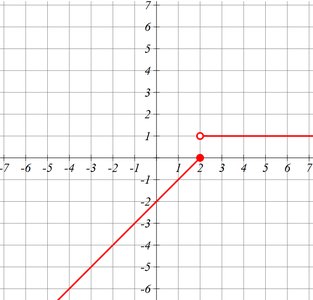
Example: For , check continuity at .
Rates of Change
Average Rate of Change
The average rate of change of a function over an interval is:
Also known as the difference quotient:
Example: For , find the average rate of change on .
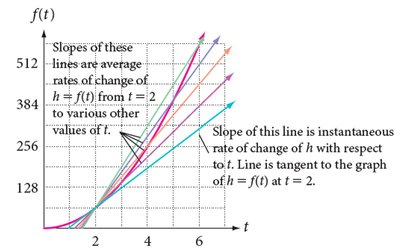
Instantaneous Rate of Change
The instantaneous rate of change at is the limit of the average rate of change as the interval shrinks to zero:
Alternate form:
This is the slope of the tangent line to the graph at .
The Derivative
Definition of the Derivative
The derivative of a function , denoted , is defined as:
It represents the slope of the tangent line and the instantaneous rate of change of with respect to .
Example: For , find using the limit definition.
Conditions for Nondifferentiability
A function is not differentiable at a point if:
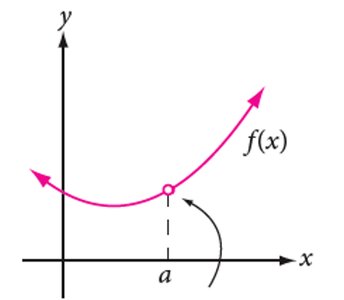
1. The function is not continuous at that point.
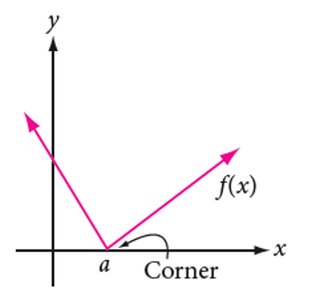
2. The function has a corner at that point.
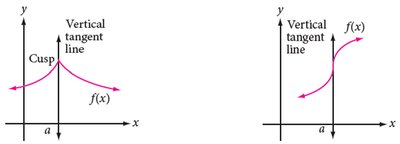
3. The function has a vertical tangent line or a cusp at that point.