 Indietro
Business Calculus Study Notes: Techniques of Differentiation and Applications
Guida di studio - Note intelligenti
 Appunti personalizzati basati sui tuoi materiali, ampliati con definizioni chiave, esempi e contesto.
Calculating the Derivative
Derivative Notations
The derivative of a function measures how the function changes as its input changes. Several notations are used to represent the derivative of a function y = f(x):
f′(x)
y′
\frac{dy}{dx}
\frac{df}{dx}
\frac{d}{dx}[f(x)]
D_x[f(x)]
Each notation expresses the rate of change of y with respect to x.
Rules for Derivatives
Derivative of a Constant: If f(x) = k, then f′(x) = 0.
Simple Power Rule: If y = x^n, then
Derivative of y = x:
Derivative of a Constant Times a Function:
Derivative of y = c x:
Derivative of a Sum or Difference:
Example: For f(x) = 6x^4 + 2x^3 - 2x^2 + 4x + 6, the derivative is:
Marginal Analysis
Economic Applications of Derivatives
Derivatives are used in business to analyze changes in revenue, cost, and profit:
Marginal Revenue (MR): The derivative of the revenue function R(x).
Marginal Cost (MC): The derivative of the cost function C(x).
Marginal Profit (MP): The derivative of the profit function P(x).
Example: If C(x) = 0.15x^2 - 18x + 960, then gives the marginal cost.
Derivatives of Products and Quotients
Product Rule
To differentiate the product of two functions:
If f(x) = u(x) v(x), then
Example: For f(x) = (x^2 - 1)(3x + 1):
Quotient Rule
To differentiate the quotient of two functions:
If f(x) = \frac{u(x)}{v(x)}, then
Example: For f(x) = \frac{2x - 1}{x + 2}:
The Chain Rule
Composition of Functions
Functions can be combined by composition, where the output of one function becomes the input of another. The composite function f ∘ g is defined as (f ∘ g)(x) = f(g(x)).
Domain: The domain of f ∘ g is all x in the domain of g such that g(x) is in the domain of f.
Example: If f(x) = 6 - x and g(x) = x^3 + 4, then (f ∘ g)(x) = 6 - (x^3 + 4).
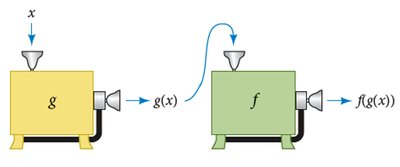
The Chain Rule
The Chain Rule is used to differentiate composite functions. If y = f(u) and u = g(x), then y = f(g(x)), and:
Alternatively,
General Power Rule: If y = [g(x)]^n, then
Derivatives of Exponential Functions
Natural Exponential Function
The derivative of the natural exponential function is:
Chain Rule for Exponential Functions:
General Exponential Function:
Derivatives of Logarithm Functions
Logarithmic Functions
The derivative of the logarithm function is:
Natural Logarithm:
Chain Rule for Logarithmic Functions:
Example: For f(x) = 6x^2 \ln x,
Summary Table: Derivative Rules
Rule | Formula |
|---|---|
Constant Rule | |
Power Rule | |
Sum/Difference Rule | |
Product Rule | |
Quotient Rule | |
Chain Rule | |
Exponential Rule | |
Logarithm Rule |
