 Indietro
Nonlinear Functions and Their Transformations in Business Calculus
Guida di studio - Note intelligenti
 Appunti personalizzati basati sui tuoi materiali, ampliati con definizioni chiave, esempi e contesto.
Nonlinear Functions
Quadratic Functions
Quadratic functions are a fundamental class of nonlinear functions, commonly encountered in business calculus for modeling profit, cost, and revenue scenarios. They are characterized by their parabolic graphs and can be expressed in two main forms:
Standard Form: , where
Vertex Form: , where and is the vertex of the parabola
The graph of a quadratic function is a parabola with the following properties:
The parabola opens upward if and downward if .
The y-intercept is at .
The x-intercepts (if they exist) are the solutions to .
The vertex is at .
The axis of symmetry is the vertical line .
Example: Profit Analysis
Suppose the revenue is given by and the cost is . To find the break-even quantity, maximum revenue, and maximum profit, set up and solve the corresponding equations using the properties above.
Transformations of Functions
Stretching and Compressing
Transformations alter the shape and position of a function's graph. Stretching and compressing affect the graph's steepness or width:
Vertical Stretch/Compression: stretches by if , compresses if .
Horizontal Stretch/Compression: compresses horizontally by if , stretches if .
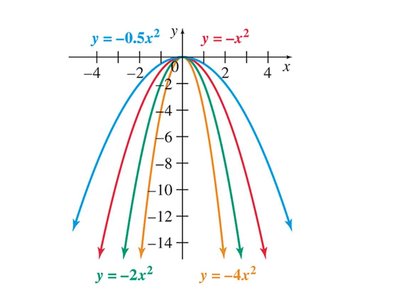
Transformation | Equation |
|---|---|
Stretch vertically by a factor of | |
Compress vertically by a factor of | |
Compress horizontally by a factor of | |
Stretch horizontally by a factor of |
Translations (Shifts)
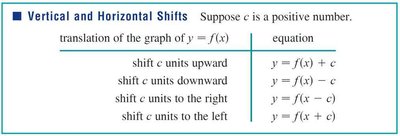
Translations move the graph without changing its shape:
Vertical Shift: shifts up by units; shifts down by $c$ units.
Horizontal Shift: shifts right by units; shifts left by $c$ units.
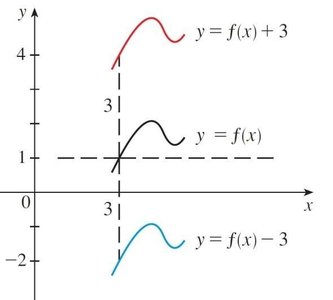
Translation | Equation |
|---|---|
Shift units upward | |
Shift units downward | |
Shift units to the right | |
Shift units to the left |
Reflections
Reflections flip the graph over a specified axis:
Reflection about the x-axis:
Reflection about the y-axis:
Reflection | Equation |
|---|---|
About the x-axis | |
About the y-axis |
Order of Transformations
When applying multiple transformations, follow this order:
Parentheses (horizontal shift)
Multiplication (stretch or compression)
Negation (reflection)
Addition/Subtraction (vertical shift)
Polynomial Functions
Definition and Properties
A polynomial function of degree is defined as , where and all coefficients are real numbers. The degree is the highest power of with a nonzero coefficient.
A polynomial of degree can have at most turning points.
If a graph has turning points, the degree is at least .
Even degree: both ends of the graph go up or down.
Odd degree: one end goes up, the other down.
Leading coefficient sign determines end behavior.
is the y-intercept.
Examples
Linear:
Quadratic:
Higher degree:
Rational Functions
Definition
A rational function is any function that can be written as the ratio of two polynomials:
, where
Asymptotes
Horizontal Asymptote: If approaches a constant as becomes large, is a horizontal asymptote.
Vertical Asymptote: If grows without bound as approaches , is a vertical asymptote. Find by setting the denominator to zero (after factoring and canceling common factors).
Exponential Functions
Definition and Properties
An exponential function with base is defined as , where and .
If , then (for , ).
The x-axis () is a horizontal asymptote.
Domain: all real numbers; Range:
Interest Applications
Exponential functions are used to model compound interest, population growth, and decay. For example, the compound interest formula is:
, where is the amount, is the principal, is the annual interest rate, is the number of compounding periods per year, and is the time in years.
Logarithmic Functions
Definition
The logarithmic function is the inverse of the exponential function. For , , and :
means
Common and Natural Logarithms
Common Logarithm: is written as
Natural Logarithm: is written as
Change of Base Theorem
The change of base formula allows you to compute logarithms with any base using common or natural logarithms:
for any positive base
Exponential Growth and Decay
General Formulas
Exponential Growth: , where
Exponential Decay: , where
These models are used for population growth, radioactive decay, and continuously compounded interest.
Summary Table: Transformations of Functions
Transformation | Equation |
|---|---|
Vertical Stretch | |
Vertical Compression | |
Horizontal Stretch | |
Horizontal Compression | |
Vertical Shift Up | |
Vertical Shift Down | |
Horizontal Shift Right | |
Horizontal Shift Left | |
Reflection about x-axis | |
Reflection about y-axis |
Additional info: This guide covers the foundational concepts of nonlinear functions, their transformations, and applications relevant to business calculus, including polynomial, rational, exponential, and logarithmic functions. It also provides a summary of how to graph and analyze these functions for practical business applications.
