Skip to main content
Statistics for Business
Il mio corso
Impara
Preparazione agli esami
AI Tutor
Guide di studio
Flashcard
Esplora
Prova l'app
Il mio corso
Impara
Preparazione agli esami
AI Tutor
Guide di studio
Flashcard
Esplora
Prova l'app
Indietro
Addition Rule definitions
Puoi toccare per girare la carta.
Mutually Exclusive Events
Puoi toccare per girare la carta.
👆
Mutually Exclusive Events
Situations where two outcomes cannot occur together, represented by non-overlapping regions in a circle diagram.
Avanzamenti del tracciato
I pulsanti di controllo sono stati cambiati in modalità "navigazione".
1/15
Flashcard correlate
Pratica correlata
Video consigliati
Addition Rule quiz
Addition Rule
15 Termini
Addition Rule
4. Probability
10 Problemi
Argomento
Ernest
Multiplication Rule: Independent Events
4. Probability
10 Problemi
Argomento
Ernest
4. Probability
9 Argomenti
17 Problemi
Capitolo
Ernest
VideoThumbView.guidedCourse
5:14
Probability of Mutually Exclusive Events
720
views
19
rank
VideoThumbView.guidedCourse
2:57
Probability of Non-Mutually Exclusive Events Example
483
views
14
rank
VideoThumbView.guidedCourse
5:14
Probability of Non-Mutually Exclusive Events
560
views
17
rank
Termini in questo insieme (15)
Nascondere definizioni
Mutually Exclusive Events
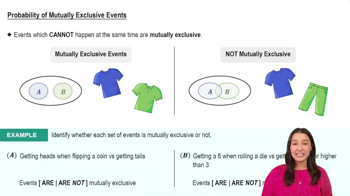
Situations where two outcomes cannot occur together, represented by non-overlapping regions in a circle diagram.
Non-Mutually Exclusive Events
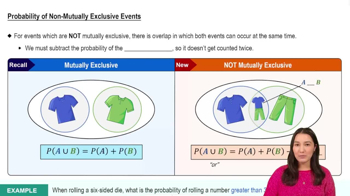
Situations where two outcomes can occur together, shown by overlapping regions in a circle diagram.
Circle Diagram
A visual tool using circles to illustrate relationships and overlaps between different events.
Overlap Region
The area in a diagram where two events intersect, indicating both outcomes occur simultaneously.
Set Notation
A symbolic way to represent events and their relationships, often using symbols like ∪ for 'or' and ∩ for 'and'.
Or Probability
The likelihood that at least one of multiple events occurs, calculated using addition and sometimes subtraction.
Addition Rule
A formula for finding the probability of either of two events, adjusting for any overlap between them.
Simplified Fraction
A reduced form of a probability ratio, making interpretation and comparison easier.
Decimal Representation
A way to express probability values as decimals, aiding in easier interpretation and comparison.
Individual Probability
The chance of a single event occurring, used as a building block in combined probability calculations.
Overlap Subtraction
The process of removing double-counted outcomes when calculating the probability of non-mutually exclusive events.
Set Union
The combination of all outcomes from two events, represented by the ∪ symbol in set notation.
Set Intersection
The collection of outcomes common to both events, represented by the ∩ symbol in set notation.
Total Possible Outcomes
The complete set of all distinct results that can occur in a probability experiment.
Exclusive Region
A part of a diagram representing outcomes unique to one event, with no overlap with others.
 IndietroIndietro
 5:14
5:14