Skip to main content
Statistics for Business
Il mio corso
Impara
Preparazione agli esami
AI Tutor
Guide di studio
Flashcard
Esplora
Prova l'app
Il mio corso
Impara
Preparazione agli esami
AI Tutor
Guide di studio
Flashcard
Esplora
Prova l'app
Indietro
Addition Rule quiz
Puoi toccare per girare la carta.
What does it mean for two events to be mutually exclusive?
Puoi toccare per girare la carta.
👆
What does it mean for two events to be mutually exclusive?
Mutually exclusive events cannot occur at the same time; if one happens, the other cannot.
Avanzamenti del tracciato
I pulsanti di controllo sono stati cambiati in modalità "navigazione".
1/15
Flashcard correlate
Pratica correlata
Video consigliati
Addition Rule definitions
Addition Rule
15 Termini
Addition Rule
4. Probability
10 Problemi
Argomento
Ernest
Multiplication Rule: Independent Events
4. Probability
10 Problemi
Argomento
Ernest
4. Probability
9 Argomenti
17 Problemi
Capitolo
Ernest
VideoThumbView.guidedCourse
5:14
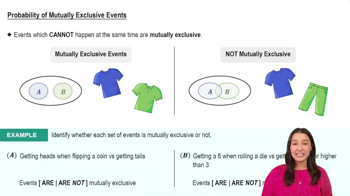
Probability of Mutually Exclusive Events
716
views
19
rank
VideoThumbView.guidedCourse
2:57
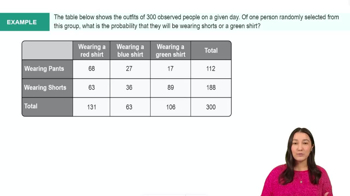
Probability of Non-Mutually Exclusive Events Example
480
views
14
rank
VideoThumbView.guidedCourse
5:14
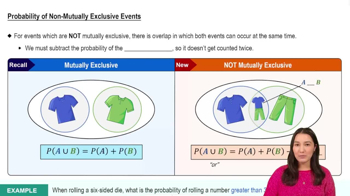
Probability of Non-Mutually Exclusive Events
556
views
17
rank
Termini in questo insieme (15)
Nascondere definizioni
What does it mean for two events to be mutually exclusive?
Mutually exclusive events cannot occur at the same time; if one happens, the other cannot.
How do you calculate the probability of two mutually exclusive events occurring?
Add the individual probabilities of each event: P(A or B) = P(A) + P(B).
What is the formula for the probability of two non-mutually exclusive events?
P(A or B) = P(A) + P(B) - P(A and B).
Why do you subtract P(A and B) when calculating the probability of non-mutually exclusive events?
Because the overlap (where both events occur) is counted twice when adding P(A) and P(B), so it must be subtracted once.
What does the symbol '∪' represent in probability notation?
The symbol '∪' means 'or' and represents the union of two events.
What does the symbol '∩' represent in probability notation?
The symbol '∩' means 'and' and represents the intersection where both events occur.
If two events are mutually exclusive, what is P(A and B)?
P(A and B) is 0 because both events cannot happen at the same time.
Give an example of two mutually exclusive events.
Getting heads or tails on a single coin flip; you cannot get both at once.
Give an example of two non-mutually exclusive events.
Rolling a six and rolling a number higher than three on a die; rolling a six satisfies both events.
How would you calculate the probability of rolling a 3 or a 5 on a six-sided die?
Add the probabilities: 1/6 (for 3) + 1/6 (for 5) = 2/6 or 1/3.
How do you find the probability of rolling a number greater than 3 or an even number on a six-sided die?
Add the probabilities of each event, then subtract the overlap: 3/6 + 3/6 - 2/6 = 4/6 or 2/3.
What is the general addition rule for any two events?
P(A or B) = P(A) + P(B) - P(A and B), regardless of mutual exclusivity.
When can you use the simple addition rule without subtracting the overlap?
When the events are mutually exclusive, since P(A and B) = 0.
What is 'or probability' in the context of probability rules?
'Or probability' refers to the probability that at least one of two events occurs.
Why is understanding mutually exclusive and non-mutually exclusive events important in probability?
It ensures you use the correct formula and avoid double-counting outcomes when calculating probabilities.
 IndietroIndietro
 5:14
5:14