 Indietro
Probability: Foundations and Rules for Business Statistics
Guida di studio - Note intelligenti
 Appunti personalizzati basati sui tuoi materiali, ampliati con definizioni chiave, esempi e contesto.
Probability
Introduction to Probability
Probability is a fundamental concept in statistics, serving as a measure of uncertainty. In business statistics, probability allows us to quantify the likelihood of various outcomes and make informed decisions based on data. Unlike inferential statistics, which uses sample data to infer population characteristics, probability starts with known population information to predict the likelihood of sample outcomes.
Probability quantifies the chance of an event occurring, ranging from 0 (impossible) to 1 (certain).
It is essential for assessing risk, reliability, and making inferences in uncertain situations.
Events, Sample Spaces, and Probability
Experiments and Sample Spaces
An experiment is any process of observation that leads to a single outcome, which cannot be predicted with certainty. The sample space (S) is the set of all possible outcomes (sample points) of an experiment.
Sample point: The most basic possible outcome of an experiment.
Sample space (S): The collection of all sample points.
Example: Tossing two coins. The sample space is S = {HH, HT, TH, TT}.
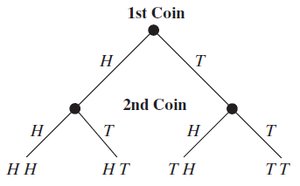
Probability Rules for Sample Points
Each sample point has a probability between 0 and 1.
The sum of probabilities for all sample points in the sample space equals 1.
Events
An event is a collection of one or more sample points. Events can be:
Simple event: Contains only one sample point.
Compound event: Contains two or more sample points.
Example: In tossing two coins, the event "at least one head" is {HH, HT, TH}.
Calculating Event Probabilities
The probability of an event A is the sum of the probabilities of the sample points in A.
Steps:
Define the experiment.
List the sample points.
Assign probabilities to sample points.
Identify the sample points in the event of interest.
Sum their probabilities.
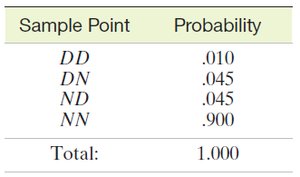
Example: Defective Smartphones
Sample Point | Probability |
|---|---|
DD | 0.010 |
DN | 0.045 |
ND | 0.045 |
NN | 0.900 |
Total | 1.000 |
Combinations Rule
The number of ways to choose n elements from N is given by the combinations formula:
where is the factorial of N.
Example: Choosing 5 ventures from 20:
Unions and Intersections
Compound Events
Compound events are formed by combining two or more events. The two main ways are unions and intersections.
Union of Events
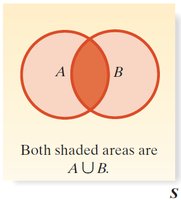
The union of events A and B (A ∪ B) occurs if either A, B, or both occur. It is an "OR" statement.
Intersection of Events
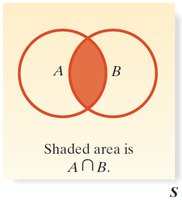
The intersection of events A and B (A ∩ B) occurs if both A and B occur. It is an "AND" statement.
Example: Die-Toss Experiment
Let A = "even number" and B = "number ≤ 3". The sample space is {1, 2, 3, 4, 5, 6}.
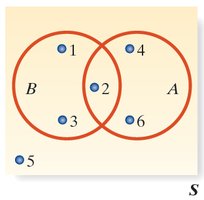
A ∪ B = {1, 2, 3, 4, 6}
A ∩ B = {2}
For a fair die:
Complementary Events
Definition and Rule of Complements
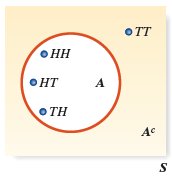
The complement of event A (denoted AC) is the event that A does not occur. The sum of the probabilities of an event and its complement is 1:
Example: Tossing two coins, A = "at least one head" = {HH, HT, TH}, AC = {TT}.
The Additive Rule and Mutually Exclusive Events
Additive Rule
The probability of the union of two events is:
Example: If 12% of patients are admitted for surgery, 16% for obstetrics, and 2% for both, then:
Mutually Exclusive Events
Events are mutually exclusive if they cannot both occur (A ∩ B = ∅). For such events:
Caution: This formula is only valid if the events are mutually exclusive.
Conditional Probability
Definition and Formula
Conditional probability is the probability of event A given that event B has occurred:
Example: If 55% of executives cheated at golf and 20% cheated at golf and lied in business, then:
The Multiplicative Rule and Independent Events
Multiplicative Rule
The probability of the intersection of two events is:
Example: If the probability of a drought is 0.05 and the probability of profit given a drought is 0.01, then:
Independent Events
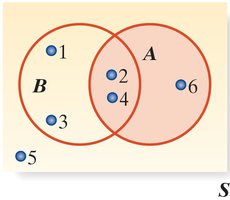
Events A and B are independent if the occurrence of one does not affect the probability of the other:
For independent events:
Bayes’s Rule
Bayes’s Rule for Conditional Probability
Bayes’s Rule allows us to update probabilities based on new information. For mutually exclusive and exhaustive events B1, B2, ..., Bk:
Example: In a wheelchair navigation scenario, Bayes’s Rule can be used to determine the most likely destination given the joystick position and prior probabilities for each destination.
Key Ideas
Probabilities for all sample points must be between 0 and 1 and sum to 1.
Combinations rule helps count possible samples.
Bayes’s Rule is essential for updating probabilities with new evidence.
