Skip to main content
Calculus
Il mio corso
Impara
Preparazione agli esami
AI Tutor
Guide di studio
Soluzioni per libri di testo
Flashcard
Esplora
Prova l'app
Il mio corso
Impara
Preparazione agli esami
AI Tutor
Guide di studio
Soluzioni per libri di testo
Flashcard
Esplora
Prova l'app
Indietro
Common Functions definitions
Puoi toccare per girare la carta.
Constant Function
Puoi toccare per girare la carta.
👆
Constant Function
A rule where every input yields the same output, resulting in a horizontal line with domain all real numbers and a single-value range.
Avanzamenti del tracciato
I pulsanti di controllo sono stati cambiati in modalità "navigazione".
1/15
Flashcard correlate
Pratica correlata
Video consigliati
Common Functions quiz
Common Functions
15 Termini
Common Functions
0. Functions
4 Problemi
Argomento
Patrick
Transformations
0. Functions
3 Problemi
Argomento
Ally
0. Functions - Part 1 of 2
7 Argomenti
14 Problemi
Capitolo
Patrick
0. Functions - Part 2 of 2
8 Argomenti
12 Problemi
Capitolo
David-Paige
7:42
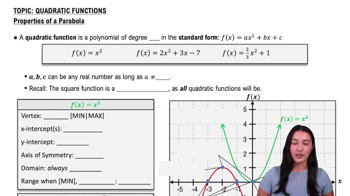
Properties of Parabolas
1972
views
53
rank
4:30
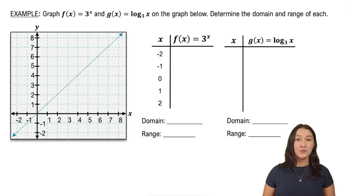
Graphing Logarithmic Functions Example 1
1272
views
46
rank
7:30
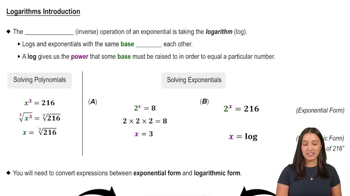
Logarithms Introduction
1548
views
45
rank
Termini in questo insieme (15)
Nascondere definizioni
Constant Function
A rule where every input yields the same output, resulting in a horizontal line with domain all real numbers and a single-value range.
Identity Function
A rule where each input equals its output, forming a straight line through the origin with both domain and range as all real numbers.
Square Function
A rule mapping each input to its square, producing a parabola opening upward with domain all real numbers and range from zero to infinity.
Cube Function
A rule mapping each input to its cube, creating a curve symmetric about the origin with both domain and range as all real numbers.
Square Root Function
A rule assigning each nonnegative input its principal square root, with domain and range both starting at zero and extending to infinity.
Cube Root Function
A rule assigning each input its cube root, resulting in a curve passing through the origin with domain and range as all real numbers.
Slope-Intercept Form
A linear equation format, y = mx + b, where m indicates steepness and b shows the y-axis crossing point.
Quadratic Function
A degree-two polynomial, typically f(x) = ax² + bx + c, whose graph is a parabola with a vertex and axis of symmetry.
Vertex
The highest or lowest point on a parabola, representing either a maximum or minimum value depending on the parabola's direction.
Axis of Symmetry
A vertical line dividing a parabola into two mirror-image halves, always passing through the vertex.
Polynomial Function
A rule involving only nonnegative integer exponents, always producing smooth, unbroken curves with domain all real numbers.
Degree
The largest exponent in a polynomial, determining the function's overall shape and the number of possible turning points.
Rational Function
A rule formed by dividing two polynomials, with domain restrictions wherever the denominator equals zero.
Exponential Function
A rule with a constant positive base (not 1) raised to a variable exponent, producing rapid growth or decay.
Logarithmic Function
A rule giving the power needed for a base to reach a number, serving as the inverse of an exponential function and featuring a vertical asymptote.
 IndietroIndietro

 7:42
7:42