Skip to main content
Calculus
Il mio corso
Impara
Preparazione agli esami
AI Tutor
Guide di studio
Soluzioni per libri di testo
Flashcard
Esplora
Prova l'app
Il mio corso
Impara
Preparazione agli esami
AI Tutor
Guide di studio
Soluzioni per libri di testo
Flashcard
Esplora
Prova l'app
Indietro
Common Functions quiz
Puoi toccare per girare la carta.
What is the domain and range of the constant function f(x) = c?
Puoi toccare per girare la carta.
👆
What is the domain and range of the constant function f(x) = c?
The domain is all real numbers, and the range is the single value c.
Avanzamenti del tracciato
I pulsanti di controllo sono stati cambiati in modalità "navigazione".
1/15
Flashcard correlate
Pratica correlata
Video consigliati
Common Functions definitions
Common Functions
15 Termini
Common Functions
0. Functions
4 Problemi
Argomento
Patrick
Transformations
0. Functions
3 Problemi
Argomento
Ally
0. Functions - Part 1 of 2
7 Argomenti
14 Problemi
Capitolo
Patrick
0. Functions - Part 2 of 2
8 Argomenti
12 Problemi
Capitolo
David-Paige
7:42
Properties of Parabolas
1969
views
52
rank
4:30
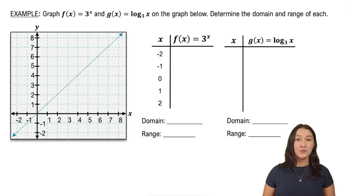
Graphing Logarithmic Functions Example 1
1269
views
46
rank
7:30
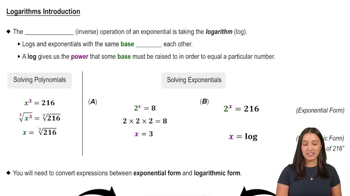
Logarithms Introduction
1546
views
45
rank
Termini in questo insieme (15)
Nascondere definizioni
What is the domain and range of the constant function f(x) = c?
The domain is all real numbers, and the range is the single value c.
What does the identity function f(x) = x output for any input x?
It outputs the same value as the input, so f(x) = x for all x.
What is the domain and range of the square function f(x) = x^2?
The domain is all real numbers, and the range is [0, ∞).
What shape does the graph of the square function f(x) = x^2 form?
It forms a parabola opening upwards.
What is the domain and range of the cube function f(x) = x^3?
Both the domain and range are all real numbers.
What is the domain and range of the square root function f(x) = √x?
The domain and range are [0, ∞).
What is the domain and range of the cube root function f(x) = ∛x?
Both the domain and range are all real numbers.
What is the slope-intercept form of a line and what do m and b represent?
The slope-intercept form is y = mx + b, where m is the slope and b is the y-intercept.
How do you find the y-intercept of a line from its graph?
The y-intercept is the y-value where the graph crosses the y-axis, at x = 0.
What is the standard form of a quadratic function and what is its graph called?
The standard form is f(x) = ax^2 + bx + c, and its graph is a parabola.
What is the axis of symmetry for a parabola and how is it related to the vertex?
The axis of symmetry is a vertical line passing through the vertex, dividing the parabola in half.
What are the requirements for a function to be a polynomial function?
All exponents must be positive whole numbers, and the graph must be smooth and continuous.
What is a rational function and how do you find its domain restrictions?
A rational function is a fraction of polynomials, and its domain excludes values that make the denominator zero.
What are the requirements for the base of an exponential function?
The base must be constant, positive, and not equal to 1.
How are logarithmic functions related to exponential functions, and how is their graph obtained?
Logarithmic functions are the inverse of exponential functions, and their graph is a reflection of the exponential graph over the line y = x.
 IndietroIndietro

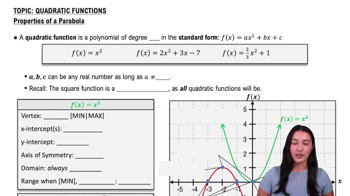
 7:42
7:42