Skip to main content
Calculus
Il mio corso
Impara
Preparazione agli esami
AI Tutor
Guide di studio
Soluzioni per libri di testo
Flashcard
Esplora
Prova l'app
Il mio corso
Impara
Preparazione agli esami
AI Tutor
Guide di studio
Soluzioni per libri di testo
Flashcard
Esplora
Prova l'app
Indietro
Motion Analysis definitions
Puoi toccare per girare la carta.
Derivative
Puoi toccare per girare la carta.
👆
Derivative
A mathematical tool that measures how a quantity changes with respect to another, often used to analyze rates in motion.
Avanzamenti del tracciato
I pulsanti di controllo sono stati cambiati in modalità "navigazione".
1/15
Flashcard correlate
Pratica correlata
Video consigliati
Motion Analysis quiz
Motion Analysis
15 Termini
Motion Analysis
4. Applications of Derivatives
3 Problemi
Argomento
Justin
Implicit Differentiation
4. Applications of Derivatives
4 Problemi
Argomento
David-Paige
4. Applications of Derivatives
5 Argomenti
10 Problemi
Capitolo
Justin
VideoThumbView.guidedCourse
06:29
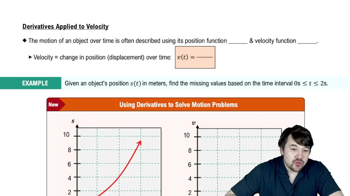
Derivatives Applied To Velocity
1529
views
32
rank
VideoThumbView.guidedCourse
06:51
Derivatives Applied To Acceleration Example 2
816
views
11
rank
VideoThumbView.guidedCourse
06:15
Derivatives Applied To Acceleration
943
views
24
rank
Termini in questo insieme (15)
Nascondere definizioni
Derivative
A mathematical tool that measures how a quantity changes with respect to another, often used to analyze rates in motion.
Position Function
A formula that gives the location of an object at any moment, typically expressed in terms of time.
Velocity
A measure of how fast and in what direction an object's position changes, found as the first derivative of position.
Acceleration
A measure of how quickly velocity changes, calculated as the first derivative of velocity or the second derivative of position.
Displacement
The net change in position over a time interval, found by subtracting initial from final position.
Average Velocity
The total change in position divided by the total change in time, representing the slope of a secant line.
Instantaneous Velocity
The rate of change of position at a specific moment, represented by the slope of a tangent line.
Speed
The magnitude of velocity, always non-negative, found by taking the absolute value of velocity.
Time Interval
A span between two time points, used to calculate changes in position, velocity, or acceleration.
Secant Line
A straight line connecting two points on a curve, used to represent average rates like average velocity.
Tangent Line
A straight line that touches a curve at one point, representing the instantaneous rate of change.
Power Rule
A differentiation technique where the exponent is multiplied by the coefficient and reduced by one.
Units
Standard quantities used to specify measurements, such as meters per second for velocity or meters per second squared for acceleration.
Slope
A measure of steepness, representing the rate of change in a graph, crucial for interpreting velocity and acceleration.
Function
A mathematical relationship assigning each input exactly one output, often used to model position, velocity, or acceleration.
 IndietroIndietro
 06:29
06:29