Skip to main content
Calculus
Il mio corso
Impara
Preparazione agli esami
AI Tutor
Guide di studio
Soluzioni per libri di testo
Flashcard
Esplora
Prova l'app
Il mio corso
Impara
Preparazione agli esami
AI Tutor
Guide di studio
Soluzioni per libri di testo
Flashcard
Esplora
Prova l'app
Indietro
Motion Analysis quiz
Puoi toccare per girare la carta.
What is the relationship between position, velocity, and acceleration in motion analysis?
Puoi toccare per girare la carta.
👆
What is the relationship between position, velocity, and acceleration in motion analysis?
Position is s(t), velocity is the first derivative of position (v = ds/dt), and acceleration is the second derivative of position (a = d^2s/dt^2).
Avanzamenti del tracciato
I pulsanti di controllo sono stati cambiati in modalità "navigazione".
1/15
Flashcard correlate
Pratica correlata
Video consigliati
Motion Analysis definitions
Motion Analysis
15 Termini
Motion Analysis
4. Applications of Derivatives
3 Problemi
Argomento
Justin
Implicit Differentiation
4. Applications of Derivatives
4 Problemi
Argomento
David-Paige
4. Applications of Derivatives
5 Argomenti
10 Problemi
Capitolo
Justin
VideoThumbView.guidedCourse
06:29
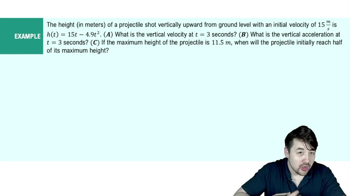
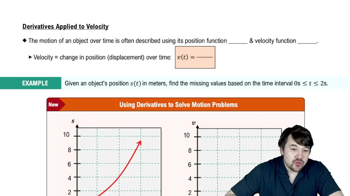
Derivatives Applied To Velocity
1528
views
32
rank
VideoThumbView.guidedCourse
06:51
Derivatives Applied To Acceleration Example 2
815
views
11
rank
VideoThumbView.guidedCourse
06:15
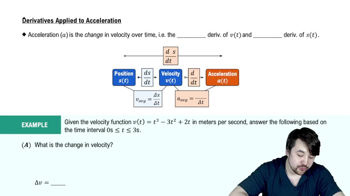
Derivatives Applied To Acceleration
942
views
24
rank
Termini in questo insieme (15)
Nascondere definizioni
What is the relationship between position, velocity, and acceleration in motion analysis?
Position is s(t), velocity is the first derivative of position (v = ds/dt), and acceleration is the second derivative of position (a = d^2s/dt^2).
How do you find the velocity function from a position function?
Take the first derivative of the position function with respect to time; v(t) = ds/dt.
What does the position function s(t) represent in motion analysis?
It represents the location of an object at a given time t.
How is displacement calculated over a time interval?
Displacement is the final position minus the initial position: s(final) - s(initial).
What is the formula for average velocity over a time interval?
Average velocity is the change in position divided by the change in time: (s(final) - s(initial)) / (t(final) - t(initial)).
How do you find instantaneous velocity at a specific time?
Plug the specific time into the velocity function; v(t) at that time gives the instantaneous velocity.
What is the difference between speed and velocity?
Speed is the absolute value of velocity and always positive, while velocity can be negative or positive depending on direction.
How do you calculate speed from velocity?
Take the absolute value of the velocity; speed = |v|.
What is the mathematical definition of acceleration?
Acceleration is the first derivative of velocity or the second derivative of position with respect to time.
How do you find the change in velocity over a time interval?
Subtract the initial velocity from the final velocity: v(final) - v(initial).
What is the formula for average acceleration?
Average acceleration is the change in velocity divided by the change in time: (v(final) - v(initial)) / (t(final) - t(initial)).
What are the units for acceleration in motion analysis?
Acceleration is measured in distance per squared time, such as meters per second squared (m/s^2).
How do you find the acceleration function from a velocity function?
Take the first derivative of the velocity function with respect to time; a(t) = dv/dt.
How do you calculate instantaneous acceleration at a specific time?
Plug the specific time into the acceleration function; a(t) at that time gives the instantaneous acceleration.
What is the difference between average and instantaneous values in motion analysis?
Average values are calculated over a time interval between two points, while instantaneous values are calculated at a single specific point in time.
 IndietroIndietro
 06:29
06:29