 Indietro
Calculus I: Limits, Continuity, and Introduction to the Derivative – Study Notes
Guida di studio - Note intelligenti
 Appunti personalizzati basati sui tuoi materiali, ampliati con definizioni chiave, esempi e contesto.
Limits and Continuity
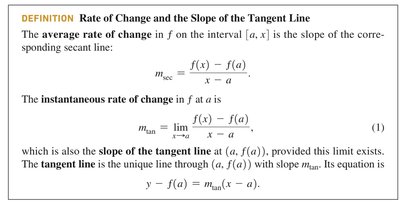
Average and Instantaneous Rate of Change
The average rate of change of a function over an interval measures how much the function's output changes per unit change in input. The instantaneous rate of change is the rate at a single point, foundational for the concept of the derivative.
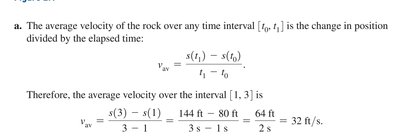
Average Rate of Change: For a function f(x) over [a, b], it is given by:
Instantaneous Rate of Change: Defined as the limit of the average rate as the interval shrinks to a point:
Example: For the position function , the average velocity over [1, 3] is: ft/s.

Evaluating Limits
Limits describe the behavior of a function as the input approaches a certain value. They are essential for defining continuity and derivatives.
First Step: Always attempt direct substitution. If this leads to an indeterminate form, use algebraic techniques.
Indeterminate Forms: Common forms include and .
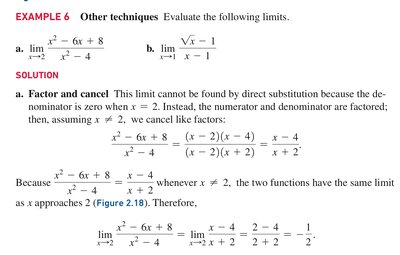
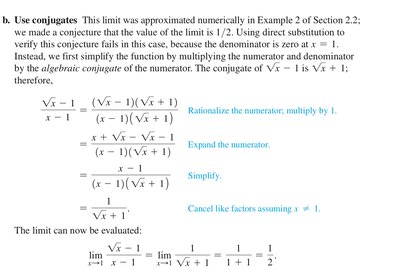
Techniques: Factor and cancel, use conjugates, or apply the Squeeze Theorem as appropriate.
Example: To evaluate , factor numerator and denominator, cancel , and substitute to get .
Infinite Limits and Asymptotes
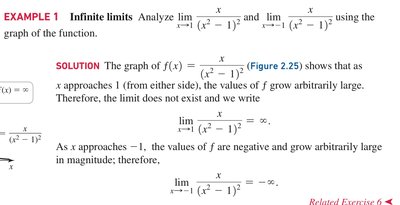
Infinite limits occur when the function grows without bound as the input approaches a certain value. These are closely related to vertical asymptotes.
Vertical Asymptote: The line is a vertical asymptote if .
Horizontal Asymptote: The line is a horizontal asymptote if or .
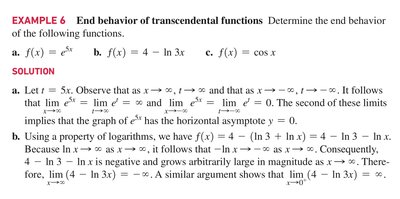
Example: For , as , ; as , .

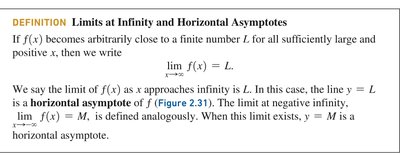
Limits at Infinity and End Behavior
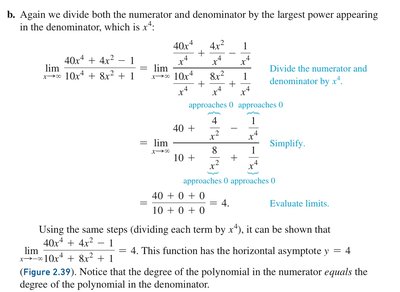
Limits at infinity describe the behavior of functions as becomes very large or very small. These are used to determine horizontal asymptotes and the end behavior of functions.
Polynomials: The end behavior depends on the degree and leading coefficient.
Rational Functions: Compare degrees of numerator and denominator to determine horizontal asymptotes.
Exponential and Logarithmic Functions: , , , .
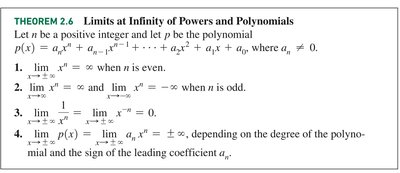
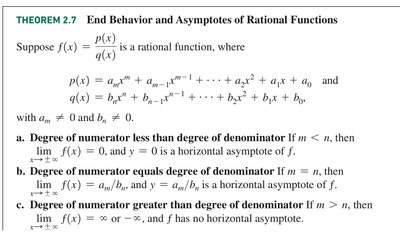
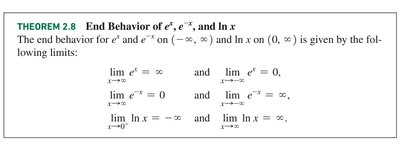
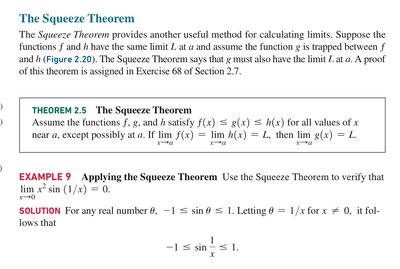
The Squeeze Theorem
The Squeeze Theorem is a powerful tool for evaluating limits of functions that are difficult to analyze directly. If a function is trapped between two others that share the same limit, it must also approach that limit.
Theorem: If near and , then .
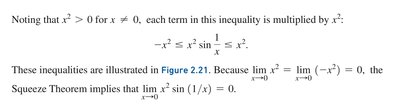
Example: by squeezing between and .
Continuity and Types of Discontinuities
A function is continuous at a point if its value matches the limit as the input approaches that point. Discontinuities are classified based on how the function fails to be continuous.
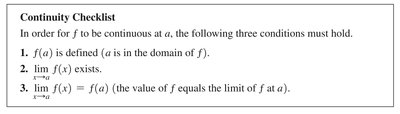
Continuity Checklist:
is defined.
exists.
.
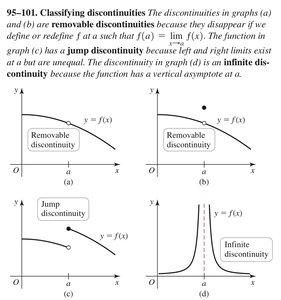
Removable Discontinuity: The limit exists, but is not defined or not equal to the limit.
Jump Discontinuity: Left and right limits exist but are not equal.
Infinite Discontinuity: The function approaches infinity at the point (vertical asymptote).

Intermediate Value Theorem
The Intermediate Value Theorem guarantees that a continuous function on a closed interval takes on every value between its endpoints.
Theorem: If is continuous on and is between and , then there exists in such that .
Introduction to the Derivative
Definition and Interpretation
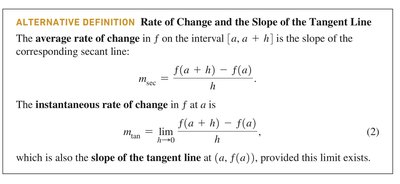
The derivative of a function at a point measures the instantaneous rate of change, or the slope of the tangent line at that point. It is defined as a limit.
Limit Definition:
Geometric Meaning: The derivative at is the slope of the tangent line to the graph at .
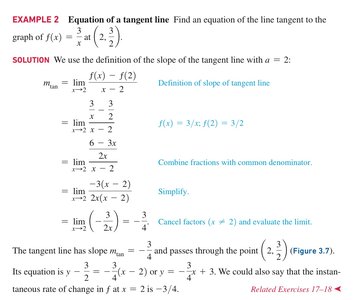
Equation of Tangent Line:

Examples: Tangent Lines and Derivatives
Finding the equation of a tangent line involves computing the derivative at a point and using the point-slope form.
Example 1: For at , , so the tangent line is .
Example 2: For at , , so the tangent line is .
Summary Table: Types of Discontinuities
Type | Description | Graphical Feature |
|---|---|---|
Removable | Limit exists, but is not defined or not equal to the limit | Hole in the graph |
Jump | Left and right limits exist but are not equal | Sudden jump in the graph |
Infinite | Function approaches infinity (vertical asymptote) | Graph shoots up or down without bound |
Practice and Further Study
Review textbook exercises from Sections 2.1–2.6 and 3.1 for additional practice on limits, continuity, and derivatives.
Focus on understanding the concepts, not just computation.
