Indietro
Foundations of Functions: Domain, Range, and Transformations
Guida di studio - Note intelligenti
 Appunti personalizzati basati sui tuoi materiali, ampliati con definizioni chiave, esempi e contesto.
Functions: Domain and Range
Understanding Domain and Range
In mathematics, a function is a relation that assigns exactly one output for each input. The domain of a function is the set of all possible input values (typically x-values), while the range is the set of all possible output values (typically y-values) that the function can produce.
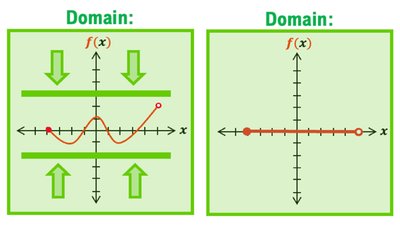
Domain: The set of all x-values for which the function is defined.
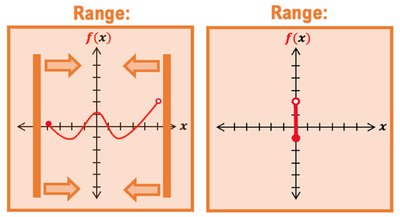
Range: The set of all y-values that the function can take.
To determine the domain and range from a graph:
Project the graph onto the x-axis to find the domain.
Project the graph onto the y-axis to find the range.
Notation for Domain and Range
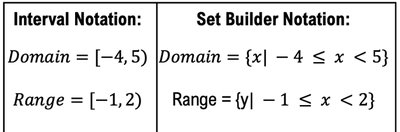
There are two common ways to express domain and range:
Interval Notation: Uses intervals to describe sets of numbers, e.g., .
Set Builder Notation: Describes the set using a property, e.g., .
Transformations of Functions
Types of Transformations
Transformations change the position or shape of a function's graph. The main types are:
Reflection: Flips the graph over a specified axis. For example, reflects over the x-axis.
Shift (Translation): Moves the graph horizontally and/or vertically. For example, shifts the graph right by units and up by units.
Stretch/Compression: Changes the steepness or width of the graph. For example, stretches the graph vertically by a factor of .
Trigonometric Functions and the Unit Circle
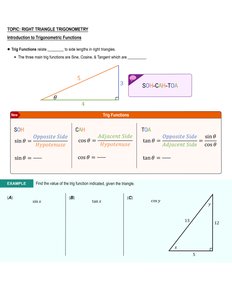
Right Triangle Trigonometry
Trigonometric functions relate the angles of a right triangle to the ratios of its side lengths. The three primary trigonometric functions are:
Sine (sin):
Cosine (cos):
Tangent (tan):
Reference Angles and the Unit Circle
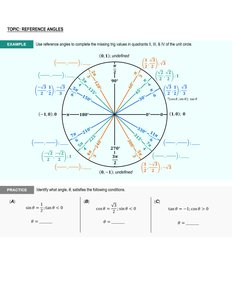
The unit circle is a circle of radius 1 centered at the origin. It is fundamental in trigonometry for defining the sine and cosine of any angle. Reference angles help determine the sign and value of trig functions in different quadrants.
In Quadrant I, all trig functions are positive.
In Quadrant II, only sine is positive.
In Quadrant III, only tangent is positive.
In Quadrant IV, only cosine is positive.
Graphs of Sine and Cosine Functions
Graphing Sine and Cosine
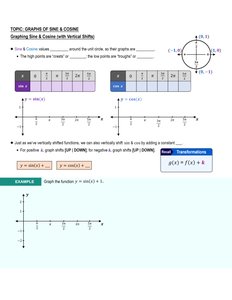
The graphs of and are periodic and oscillate between -1 and 1. They can be shifted vertically or horizontally, and their amplitude and period can be changed by transformations.
Vertical Shift: shifts the graph up by units.
Amplitude: The maximum value from the centerline, determined by the coefficient in front of the function.
Period: The length of one complete cycle, for and .
Graphs of Secant, Cosecant, Tangent, and Cotangent
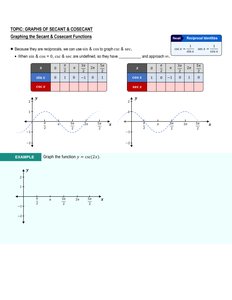
Secant and Cosecant
The secant and cosecant functions are the reciprocals of cosine and sine, respectively. Their graphs have vertical asymptotes where the original function is zero.
Tangent and Cotangent
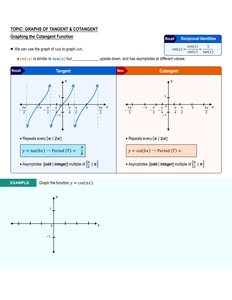
The tangent and cotangent functions are defined as ratios of sine and cosine:
Their graphs have vertical asymptotes where the denominator is zero, and they repeat every units.
Trigonometric Identities
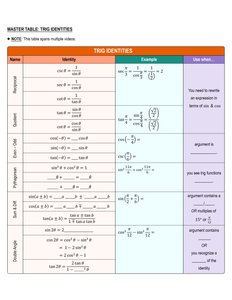
Master Table of Trig Identities
Trigonometric identities are equations involving trig functions that are true for all values in their domains. They are essential for simplifying expressions and solving equations.
Pythagorean Identities:
Reciprocal Identities: , ,
Quotient Identities: ,