 Indietro
MATH 203: Differential & Integral Calculus I – Course Syllabus and Preparation Guide
Guida di studio - Note intelligenti
 Appunti personalizzati basati sui tuoi materiali, ampliati con definizioni chiave, esempi e contesto.
Course Overview
MATH 203: Differential & Integral Calculus I is an introductory university-level calculus course at Concordia University, designed for students in science and engineering programs. The course covers foundational topics in calculus, including functions, limits, derivatives, and their applications, as well as an introduction to integration. Success in this course requires a strong background in algebra and trigonometry.
Prerequisites and Placement
Prerequisite: MATH 201 or equivalent background in algebra and trigonometry.
Pre-test: A diagnostic test is available on the course Moodle site to help students assess their readiness for MATH 203. Students scoring below 11 are strongly advised to take MATH 201 first.
Course Structure and Resources
Lectures: Scheduled weekly; details provided by the instructor.
Tutorials: Weekly sessions focused on problem-solving and review of prerequisite material.
Math Help Centre: Drop-in support staffed by graduate students for course and background mathematics questions.
Online Systems:
WeBWorK: Platform for online assignments and practice problems.
MyLab Math: E-textbook access, practice exercises, and additional resources.
Textbook: Thomas' Calculus: Early Transcendentals, Single Variable (Pearson Edition).
Grading Scheme
Assignments: 10% (completed via WeBWorK; no late submissions accepted)
Midterm Test: 30% (covers weeks 1–6; no make-up test; if missed, final exam weight increases to 90%)
Final Exam: 60% or 90% (comprehensive; 3 hours)
Note: The higher of the two grading options is used; there is no "100% final exam" option.
Course Contents and Weekly Topics
The course follows the structure below, with recommended textbook problems for each section:
Week | Sections | Main Topics |
|---|---|---|
1 | 1.2, 1.3, 1.5 | Combining Functions; Shifting & Scaling Graphs; Trigonometric Functions; Exponential Functions |
2 | 1.6, 2.1 | Inverse Functions and Logarithms; Rates of Change and Tangent Lines |
3 | 2.2, 2.4, 2.6 | Limit of a Function and Limit Laws; One-Sided Limits; Limits Involving Infinity; Asymptotes |
4 | 2.5, 3.1, 3.2 | Continuity; Tangent Lines and the Derivative; The Derivative as a Function |
5 | 3.3, 3.5 | Differentiation Rules; Derivatives of Trigonometric Functions |
6 | 3.6, 3.7 | The Chain Rule; Implicit Differentiation |
7 | 3.8, 3.9, 1.6 | Derivatives of Inverse Functions and Logarithms; Inverse Trigonometric Functions; Review of Arc Sine and Arc Cosine |
8 | 3.10, 3.11 | Related Rates; Linearization and Differentials |
9 | 4.5, 4.1 | Indeterminate Forms; L'Hôpital's Rule; Extreme Values of Functions |
10 | 4.3, 4.4 | Monotonic Functions; Concavity and Curve Sketching |
11 | 4.6 | Applied Optimization |
12 | Review | Comprehensive Review of Course Material |
Choosing the Right Math Course
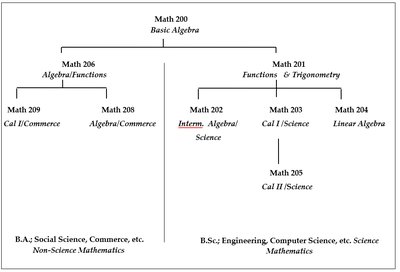
Students unsure about their placement should consider their background and performance on the qualifying test. The following diagram illustrates the progression of mathematics courses at Concordia University:
Preparation: Qualifying Test Sample Questions
The qualifying test covers essential algebra and trigonometry skills required for success in calculus. Sample topics include:
Equations of lines and slopes
Factoring and quadratic equations
Properties of circles and triangles
Trigonometric values and identities
Logarithmic and exponential expressions
Students scoring 10 or less are strongly advised to take Math 201 before Math 203. Scores of 11–14 should consult an advisor; 15 or higher indicates readiness for Math 203.
Academic Integrity and Student Conduct
Students must adhere to Concordia University's Academic Code of Conduct and policies on academic integrity.
Respectful and professional behavior is expected in all course-related activities and communications.
Intellectual property rights apply to all course materials; unauthorized distribution is prohibited.
Official university communications are conducted via Concordia email accounts.
Additional Student Support
Access to student services, academic advising, and support resources is available through the university website.
Extraordinary circumstances may result in changes to course delivery or evaluation; students will be notified as needed.
