 Indietro
Precalculus and Algebra Review for Calculus: Step-by-Step Guidance
Guida di studio - Note intelligenti
 Appunti personalizzati basati sui tuoi materiali, ampliati con definizioni chiave, esempi e contesto.
Q1. Let be given. Find the graph of the inverse function of .
Background
Topic: Inverse Functions and Exponential Functions
This question tests your understanding of how to find the inverse of an exponential function and how to graph it.
Key Terms and Formulas:
Inverse function: If is a function, its inverse satisfies .
Exponential function: is the base- exponential function.
To find the inverse, solve for in terms of .
Step-by-Step Guidance
Write the function as .
Isolate by subtracting 2 from both sides: .
Take the natural logarithm of both sides to solve for : .
Express the inverse function: .
Think about the domain of the inverse function: For , .
Try solving on your own before revealing the answer!
Final Answer:
The inverse function is , and its graph is a logarithmic curve shifted right by 2 units.
The domain of the inverse is .
Q2. Find the domain of the function .
Background
Topic: Domain of Rational Functions
This question tests your ability to determine the domain of a rational function by identifying values that make the denominator zero.
Key Terms and Formulas:
Domain: The set of all values for which the function is defined.
Rational function: A function of the form .
Denominator cannot be zero: .
Step-by-Step Guidance
Set the denominator equal to zero: .
Expand to .
Rewrite the equation: .
Solve for to find values that make the denominator zero.
The domain excludes these values.
Try solving on your own before revealing the answer!
Final Answer:
The domain is all real numbers except the solutions to .
These are the values of that make the denominator zero.
Q3. Find the domain of the function .
Background
Topic: Domain of Logarithmic Functions
This question tests your ability to find the domain of a logarithmic function, which requires the argument to be positive.
Key Terms and Formulas:
Logarithmic function: is defined only for .
Argument: .
Step-by-Step Guidance
Set the argument greater than zero: .
Analyze when the fraction is positive: and , or and .
Since , gives .
Consider if there are any other intervals where the argument is positive.
Try solving on your own before revealing the answer!
Final Answer:
The domain is .
The logarithm is defined only when the argument is positive.
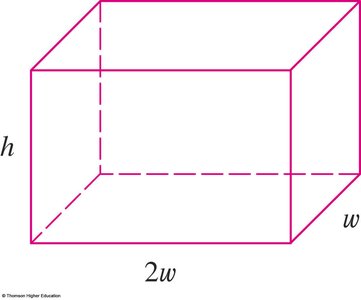
Q4. A rectangular storage container with an open top has a volume of . The length of its base is twice its width. Material for the base costs $10 per square meter. Express the cost of materials as a function of the width of the base.
Background
Topic: Optimization and Cost Functions
This question tests your ability to express a cost function in terms of a variable, using geometric relationships and algebraic manipulation.
Key Terms and Formulas:
Volume of a box: .
Area of base: .
Area of sides: .
Cost: .
Step-by-Step Guidance
Let the width be , so the length is .
Let the height be . The volume is .
Solve for in terms of : .
Calculate the area of the base: .
Calculate the area of the sides: .
Express the total cost as a function of using the formulas above.
Try solving on your own before revealing the answer!
Final Answer:
The cost function is , where .
Substitute to get .
Q5. The population of a certain country (in millions) at time (in years) is modeled as , where is the year 2000. When will the population reach 12 million?
Background
Topic: Exponential Growth and Solving Equations
This question tests your ability to solve exponential equations for a given value.
Key Terms and Formulas:
Exponential growth: .
To solve for , set and solve for .
Step-by-Step Guidance
Set : .
Divide both sides by 4: .
Take the natural logarithm of both sides: .
Solve for by dividing both sides by 0.05.
Try solving on your own before revealing the answer!
Final Answer:
years after 2000, so the population will reach 12 million around the year 2022.
Q6. Determine the period, maximum, and minimum value of the sinusoidal function .
Background
Topic: Sinusoidal Functions
This question tests your understanding of the properties of sine functions, including amplitude, period, and vertical shift.
Key Terms and Formulas:
General form: .
Amplitude: .
Period: .
Vertical shift: .
Step-by-Step Guidance
Identify amplitude: .
Identify period: .
Identify vertical shift: $3$.
Maximum value: .
Minimum value: .
Try solving on your own before revealing the answer!
Final Answer:
Period: , Maximum: $7-1$.
The function oscillates between and $7\frac{\pi}{2}$.
Q7. Build a sinusoidal formula for , the number of daylight hours as a function of , where is the number of days after January 1. The number of sunlight hours oscillates between 9.5 and 14.5 on the yearly cycle (1 year = 364 days). The longest day is the summer solstice, which is 170 days after January 1.
Background
Topic: Sinusoidal Modeling
This question tests your ability to model periodic phenomena using sinusoidal functions.
Key Terms and Formulas:
General form: .
Amplitude: .
Vertical shift: .
Period: days.
Phase shift: is the day of maximum.
Step-by-Step Guidance
Calculate amplitude: .
Calculate vertical shift: .
Period is $364\frac{2\pi}{364}$.
Phase shift is $170t = 170$).
Write the formula: .
Try solving on your own before revealing the answer!
Final Answer:
models the daylight hours as a function of days after January 1.
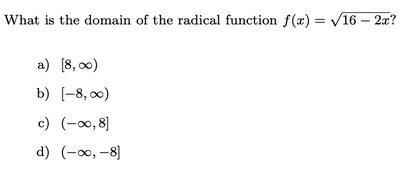
Q8. What is the domain of the radical function ?
Background
Topic: Domain of Radical Functions
This question tests your ability to find the domain of a function involving a square root, which requires the argument to be non-negative.
Key Terms and Formulas:
Radical function: is defined only when .
Set .
Step-by-Step Guidance
Set the argument of the square root greater than or equal to zero: .
Solve for : .
Divide both sides by (remember to reverse the inequality): .
Write the domain in interval notation.
Try solving on your own before revealing the answer!
Final Answer:
The domain is .
The function is defined for all less than or equal to 8.
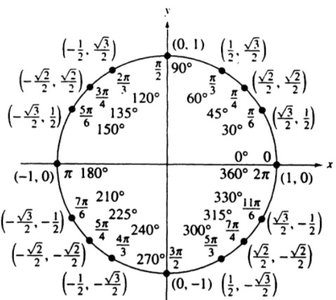
Q9. Unit Circle: Reference for Trigonometric Functions
Background
Topic: Trigonometric Functions and the Unit Circle
The unit circle is a fundamental tool for understanding the values of sine, cosine, and tangent at various angles, and is essential for solving trigonometric equations.
Key Terms and Formulas:
Unit circle: A circle of radius 1 centered at the origin.
Coordinates correspond to for angle .
Common angles: , etc.
Step-by-Step Guidance
Use the unit circle to find sine, cosine, and tangent values for common angles.
Apply these values when solving trigonometric equations or evaluating functions.
Remember the symmetry and periodicity of trigonometric functions.
Try solving on your own before revealing the answer!
Final Answer:
The unit circle provides exact values for trigonometric functions at standard angles, which are crucial for solving equations and understanding periodic behavior.
