 Indietro
Rates of Change as Limits & The Definition of the Derivative: Differentiability
Guida di studio - Note intelligenti
 Appunti personalizzati basati sui tuoi materiali, ampliati con definizioni chiave, esempi e contesto.
Rates of Change as Limits
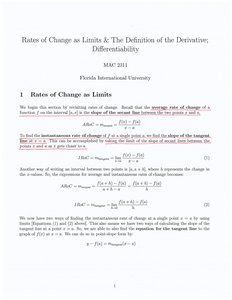
Average Rate of Change
The average rate of change of a function f on the interval [a, b] is the slope of the secant line that joins the two points (a, f(a)) and (b, f(b)) on the graph of f. It is given by:
Formula:
Interpretation: Measures how much the function changes per unit interval between a and b.
Application: Used to estimate the overall change in a function over a specified interval.
Instantaneous Rate of Change (Slope of Tangent Line)
The instantaneous rate of change at a point a is the slope of the tangent line to the graph at (a, f(a)). It is defined as the limit of the average rate of change as b approaches a:
Formula:
Alternate Form:
Application: Used to find the exact slope at a single point, which is fundamental in calculus.
Example: Finding the Slope of the Tangent Line
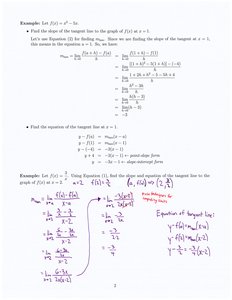
Let f(x) = x^2. To find the slope of the tangent line at x = a:
Apply the limit definition:
Simplify:
The slope at x = a is 2a.
Equation of the Tangent Line
Once the slope is found, the equation of the tangent line at x = a is:
Point-slope form: , where m is the slope at x = a.
For f(x) = x^2 at x = 1: Slope is 2, so .
The Derivative Function
Limit Definition of the Derivative
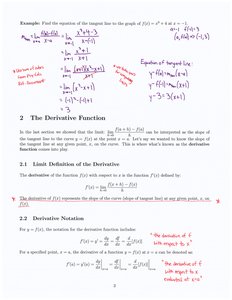
The derivative of a function f at a point a is the limit of the difference quotient as h approaches 0. This measures the instantaneous rate of change of f at a:
Definition:
Interpretation: The derivative function f' gives the slope of the tangent line at any point x.
Derivative Notation
Several notations are used for the derivative:
Leibniz notation: or
Lagrange notation:
Newton notation: (rarely used in calculus courses)
Application: Notation is chosen based on context, such as physics or mathematics.
Examples: Using the Limit Definition
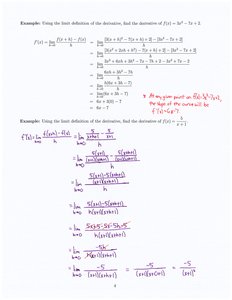
Find the derivative of f(x) = 3x^2 - 2x + 2 using the limit definition:
Apply:
Expand and simplify:
Result:
The Derivative at a Point
Evaluating the Derivative at a Specific Point
The derivative at a point a is found by evaluating the limit definition at x = a:
Formula:
Application: Used to find the slope of the tangent line at a specific point.
Example: For f(x) = 3x^2 - 2x at x = 1:
Result: Slope at x = 1 is 1.
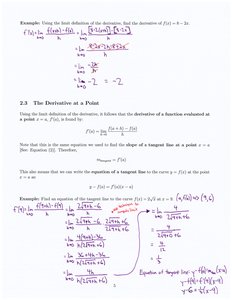
Equation of Tangent Line at a Point
Once the derivative at a point is found, the tangent line equation is:
Formula:
Example: For f(x) = 3x^2 - 2x at x = 1:
Summary Table: Derivative Concepts
Concept | Formula | Interpretation |
|---|---|---|
Average Rate of Change | Slope of secant line between two points | |
Instantaneous Rate of Change | Slope of tangent line at a point | |
Derivative Function | Function giving slope at any x | |
Derivative at a Point | Slope at specific point x = a |
Additional info: The notes provide foundational concepts for Chapter 3 (Derivatives) and Chapter 4 (Applications of the Derivative) in a Calculus course, including definitions, formulas, and worked examples for finding derivatives and tangent lines using limits.
