 Indietro
Step-by-Step Calculus Guidance: Integration, Area, Volume, Trigonometric Substitution, Partial Fractions, Numerical Methods, and Improper Integrals
Guida di studio - Note intelligenti
 Appunti personalizzati basati sui tuoi materiali, ampliati con definizioni chiave, esempi e contesto.
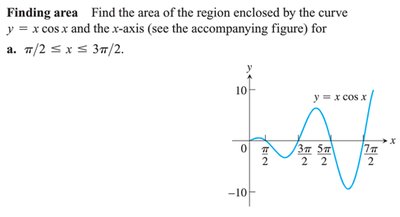
Q1. Find the area of the region enclosed by the curve and the x-axis for .
Background
Topic: Applications of Definite Integrals
This question tests your ability to use definite integrals to find the area between a curve and the x-axis, especially when the curve crosses the axis.
Key Terms and Formulas:
Definite Integral: gives the net area between and the x-axis from to .
Absolute Value: If the curve crosses the x-axis, you may need to split the integral and take absolute values to find the total enclosed area.
Step-by-Step Guidance
Identify the interval: goes from to .
Set up the definite integral: .
Check where crosses the x-axis in this interval (i.e., where ).
If the function changes sign, split the integral at those points and use absolute values to sum the areas.
Use integration by parts to evaluate (choose , ).
Try solving on your own before revealing the answer!
Final Answer:
The area is $4$.
We split the integral at (where ), compute each part, and sum the absolute values.
Q2. Find the volume of the solid generated by revolving the region bounded by , , and the x-axis about the y-axis.
Background
Topic: Volumes of Solids of Revolution
This question tests your ability to use the method of cylindrical shells to find the volume generated by revolving a region about the y-axis.
Key Terms and Formulas:
Cylindrical Shells Method: for revolution about the y-axis.
Limits: goes from $0\pi$.
Step-by-Step Guidance
Set up the volume integral using the shell method: .
Simplify the integrand: .
Use integration by parts to evaluate (choose , ).
Apply the limits and after integrating.
Try solving on your own before revealing the answer!
Final Answer:
The volume is .
Integration by parts is used twice, and the result is evaluated at the endpoints.
Q3. Consider the region bounded by , , and .
Background
Topic: Area and Volume Applications of Integrals
This question tests your ability to find the area between curves and the volume of a solid formed by revolving a region about the y-axis.
Key Terms and Formulas:
Area:
Volume (Shell Method):
Step-by-Step Guidance
For area: Set up .
For volume: Set up .
For both, consider substitution or integration by parts as needed.
Evaluate the integrals, but stop before the final calculation.
Try solving on your own before revealing the answer!
Final Answer:
a. Area:
b. Volume:
Integration by parts is used for both calculations.
Q4. Find the area between and .
Background
Topic: Area Between Curves
This question tests your ability to set up and evaluate the area between two curves using definite integrals.
Key Terms and Formulas:
Area:
Find intersection points to determine limits of integration.
Step-by-Step Guidance
Set to find intersection points.
Determine the limits of integration based on the intersection points.
Set up the area integral: .
Simplify the integrand and prepare for integration.
Try solving on your own before revealing the answer!
Final Answer:
The area is .
Limits are and , and the integral is evaluated accordingly.
Q5. Find the average value of on the closed interval .
Background
Topic: Average Value of a Function
This question tests your ability to use the formula for the average value of a function over a closed interval.
Key Terms and Formulas:
Average Value:
Here, , , .
Step-by-Step Guidance
Set up the average value formula: .
Use integration by parts to evaluate .
Apply the limits and after integrating.
Try solving on your own before revealing the answer!
Final Answer:
The average value is .
Integration by parts gives the result, and the average is calculated over the interval.
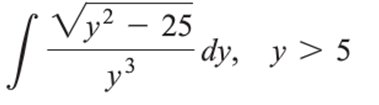
Q6. Evaluate .
Background
Topic: Trigonometric Substitution
This question tests your ability to use trigonometric substitution to evaluate integrals involving square roots of quadratic expressions.
Key Terms and Formulas:
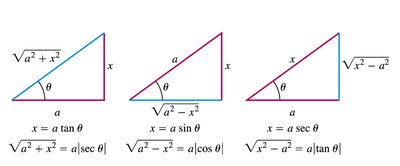
Trigonometric Substitution: For , use .
Identity: .
Step-by-Step Guidance
Let , so .
Substitute into the integral and simplify the expression.
Integrate with respect to .
Convert back to using the triangle relationships.
Try solving on your own before revealing the answer!
Final Answer:
Trigonometric substitution leads to an inverse hyperbolic function.
Q7. Evaluate .
Background
Topic: Integration Using Substitution
This question tests your ability to use substitution and recognize standard integral forms.
Key Terms and Formulas:
Substitution: or as appropriate.
Standard Form: .
Step-by-Step Guidance
Factor the denominator: .
Rewrite the integral in terms of the standard form.
Apply the limits and after integrating.
Try solving on your own before revealing the answer!
Final Answer:
We used the standard arctangent integral formula.
Q8. Evaluate .
Background
Topic: Trigonometric Substitution
This question tests your ability to use trigonometric substitution for integrals involving square roots and powers.
Key Terms and Formulas:
For , use .
Identity: .
Step-by-Step Guidance
Let , so .
Substitute into the integral and simplify.
Integrate with respect to .
Convert back to using the triangle relationships.
Try solving on your own before revealing the answer!
Final Answer:
Trigonometric substitution and simplification lead to the result.
Q9. Evaluate .
Background
Topic: Trigonometric Substitution
This question tests your ability to use trigonometric substitution for integrals involving square roots and powers.
Key Terms and Formulas:
For , use .
Identity: .
Step-by-Step Guidance
Let , so .
Substitute into the integral and simplify.
Integrate with respect to .
Convert back to using the triangle relationships.
Try solving on your own before revealing the answer!
Final Answer:
Trigonometric substitution and simplification lead to the result.
Q10. Evaluate .
Background
Topic: Substitution in Integration
This question tests your ability to use substitution for integrals involving logarithmic expressions.
Key Terms and Formulas:
Substitution: Let , .
Limits: When , ; when , .
Step-by-Step Guidance
Let , so .
Rewrite the integral in terms of and adjust the limits.
Integrate with respect to .
Try solving on your own before revealing the answer!
Final Answer:
Substitution simplifies the integral to a standard form.
Q11. Evaluate .
Background
Topic: Partial Fraction Decomposition
This question tests your ability to decompose rational functions into partial fractions and integrate.
Key Terms and Formulas:
Partial Fractions: can be written as .
Integrate each term separately.
Step-by-Step Guidance
Factor the denominator: .
Set up the partial fraction decomposition.
Solve for and .
Integrate each term.
Try solving on your own before revealing the answer!
Final Answer:
Partial fraction decomposition and integration of logarithmic terms.
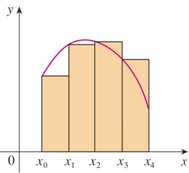
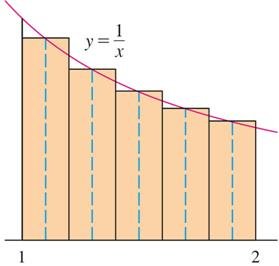
Q12. Estimate the integral using the Trapezoidal Rule and Simpson's Rule, and find error bounds.
Background
Topic: Numerical Integration
This question tests your ability to use numerical methods (Trapezoidal Rule and Simpson's Rule) to approximate definite integrals and estimate errors.
Key Terms and Formulas:
Trapezoidal Rule:
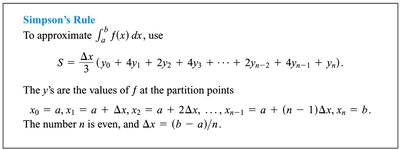
Simpson's Rule:
Error bounds: ,
Step-by-Step Guidance
Divide the interval into subintervals and calculate .
Apply the Trapezoidal Rule formula using the function values at partition points.
Apply Simpson's Rule formula (ensure is even).
Estimate the error bounds using the provided formulas.
Try solving on your own before revealing the answer!
Final Answer:
Trapezoidal Rule and Simpson's Rule give close approximations; error bounds depend on the second and fourth derivatives of the function.
Simpson's Rule is generally more accurate for smooth functions.
Q13. State whether the improper integral converges or diverges.
Background
Topic: Improper Integrals
This question tests your ability to determine convergence or divergence of improper integrals with infinite limits.
Key Terms and Formulas:
Improper Integral:
Compare to ; converges if .
Step-by-Step Guidance
Set up the limit: .
Integrate and evaluate at and .
Take the limit as .
Try solving on your own before revealing the answer!
Final Answer:
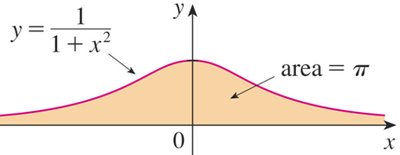
The integral converges.
The area under from to infinity is finite.
