 Indietro
Tangential and Normal Components of Acceleration, Curvature, and Torsion in Space Curves
Guida di studio - Note intelligenti
 Appunti personalizzati basati sui tuoi materiali, ampliati con definizioni chiave, esempi e contesto.
Vector-Valued Functions and Motion in Space
13.5 Tangential and Normal Components of Acceleration
This section explores the geometric and analytic properties of curves in space, focusing on the TNB frame (also known as the Frenet frame), and the decomposition of acceleration into tangential and normal components. It also introduces the concepts of curvature and torsion, which describe how a curve bends and twists in space.
The Binormal Vector
The binormal vector B is a fundamental concept in the study of space curves. It is defined as the cross product of the unit tangent vector T and the principal unit normal vector N:
Definition:
Properties:
B is a unit vector orthogonal to both T and N.
If the curve lies in a plane, B is perpendicular to that plane. If not, B measures the tendency of the curve to twist out of the plane.
The TNB (Frenet) Frame
The TNB frame consists of three mutually orthogonal unit vectors: the tangent (T), normal (N), and binormal (B). This moving frame provides a natural coordinate system for describing the motion and geometry of a particle along a curve in space.
Tangent vector (T):
Principal normal vector (N):
Binormal vector (B):
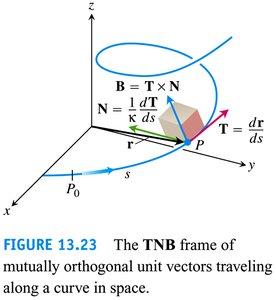
Significance: The TNB frame is especially useful for analyzing the motion of particles and the geometry of curves in three-dimensional space.
Decomposition of Acceleration: Tangential and Normal Components
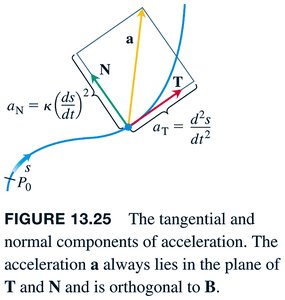
The acceleration vector of a particle moving along a curve can be decomposed into components along the tangent and normal directions:
Acceleration in TNB frame:
Tangential component: (rate of change of speed)
Normal component: (measures how sharply the curve is turning)
Key Points:
The acceleration vector always lies in the plane determined by T and N and is orthogonal to B.
If the speed is constant, and only the normal component remains.
If the speed increases, both components may be present.
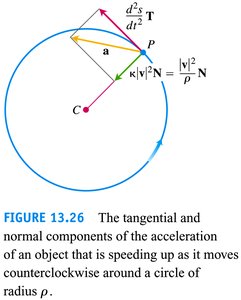
Example: For motion around a circle of radius , and .
Formulas for Tangential and Normal Components
Magnitude of acceleration:
Normal component (alternative):
Torsion of a Curve
Torsion measures the rate at which a curve twists out of the osculating plane. It is defined as follows:
Definition:
Interpretation: Torsion can be positive, negative, or zero, and is an intrinsic property of the curve.
Vertex: A point where torsion is zero is called a vertex of the curve.
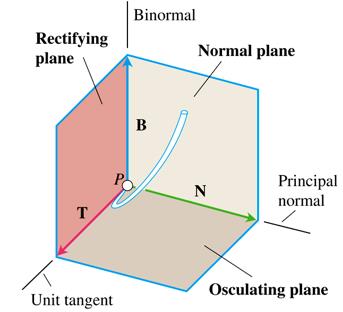
Geometric Planes:
Osculating plane: Contains T and N.
Normal plane: Contains N and B.
Rectifying plane: Contains T and B.
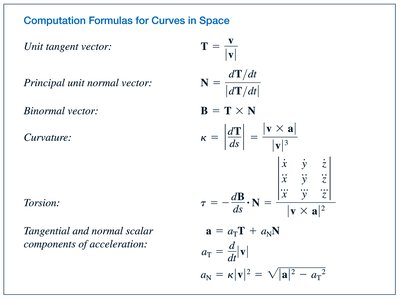
Computation Formulas for Curves in Space
The following formulas summarize the computation of the TNB frame, curvature, torsion, and the components of acceleration for a space curve :
Quantity | Formula |
|---|---|
Unit tangent vector | |
Principal unit normal vector | |
Binormal vector | |
Curvature | |
Torsion | |
Acceleration decomposition | |
Tangential component | |
Normal component |
Summary
The TNB frame provides a natural, moving coordinate system for curves in space.
Acceleration can be decomposed into tangential and normal components, which describe changes in speed and direction, respectively.
Curvature and torsion are intrinsic geometric properties that measure how a curve bends and twists.
Direct computation formulas allow for efficient calculation of these quantities from the parametric equations of a curve.
