
Ch. 1 - Functions
Briggs - Calculus: Early Transcendentals 3rd Edition
Briggs3rd EditionCalculus: Early TranscendentalsISBN: 9780136847243Non è quello che usi tu?Cambia libro di testo
Capitolo 1, Problema 34

Composite functions and notation
Let ƒ(x)= x² - 4 , g(x) = x³ and F(x) = 1/(x-3).
Simplify or evaluate the following expressions.
F(y⁴)

Guida verificata passo dopo passo
1
Identify the function F(x) given as F(x) = \(\frac{1}{x-3}\).
Substitute y^4 for x in the function F(x) to find F(y^4).
This substitution gives F(y^4) = \(\frac{1}{y^4 - 3}\).
Simplify the expression if possible, but in this case, it is already in its simplest form.
Conclude that F(y^4) = \(\frac{1}{y^4 - 3}\) is the simplified expression.

Risposta video verificata per un problema simile:

Questa soluzione video è stata consigliata dai nostri tutor come utile per risolvere questo problema.
Durata del video:
1m

Concetti chiave

Ecco i concetti essenziali che devi comprendere per rispondere correttamente alla domanda.

Composite Functions

Composite functions are formed when one function is applied to the result of another function. In this case, if we have functions f and g, the composite function (f ∘ g)(x) means f(g(x)). Understanding how to evaluate composite functions is crucial for simplifying expressions like F(y⁴), where F is applied to the output of another function.
Video consigliato:
3:48
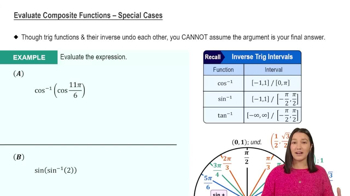
Evaluate Composite Functions - Special Cases

Function Notation

Function notation is a way to denote functions and their inputs clearly. For example, F(x) indicates that F is a function of x. In the expression F(y⁴), y⁴ is the input to the function F. Familiarity with function notation helps in correctly interpreting and manipulating expressions involving multiple functions.
Video consigliato:
Percorso guidato
7:24
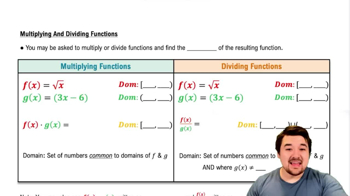
Multiplying & Dividing Functions

Simplification of Expressions

Simplification involves reducing an expression to its simplest form, making it easier to work with. This can include combining like terms, factoring, or substituting values. In the context of the given question, simplifying F(y⁴) requires substituting y⁴ into the function F and then performing any necessary algebraic operations to express the result in a more manageable form.
Video consigliato:
6:36
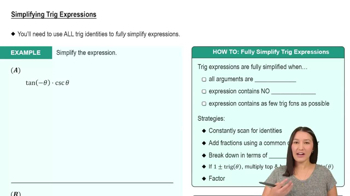
Simplifying Trig Expressions
Pratica correlata
Domanda del libro di testo

Draining a tank (Torricelli’s law) A cylindrical tank with a cross-sectional area of 1010 m2 is filled to a depth of 2525 m with water. At t=0t=0 s, a drain in the bottom of the tank with an area of 11 m²  is opened, allowing water to flow out of the tank. The depth of water in the tank (in meters) at time t≥0t\(\geq{0}\) is d(t)=(5−0.22t)2d\(\left\)(t\(\right\))=\(\left\)(5-0.22t\(\right\))^2.

b. At what time is the tank empty?

511
views
Domanda del libro di testo

The graph of ƒ is shown in the figure. Graph the following functions. <IMAGE>

a. ƒ(x+1)ƒ( x + 1)

272
views
Domanda del libro di testo

Composite functions and notation

Let ƒ(x)= x² - 4 , g(x) = x³ and F(x) = 1/(x-3). Simplify or evaluate the following expressions.

g(1/z)

389
views
Domanda del libro di testo

Composite functions and notation

Let ƒ(x)= x² - 4 , g(x) = x³ and F(x) = 1/(x-3).

Simplify or evaluate the following expressions.

F(F(x))

269
views
Domanda del libro di testo

Composite functions and notation

Let ƒ(x)= x² - 4 , g(x) = x³ and F(x) = 1/(x-3).

Simplify or evaluate the following expressions.

F(g(y))

227
views
Domanda del libro di testo

Draining a tank (Torricelli’s law) A cylindrical tank with a cross-sectional area of 1010 m2 is filled to a depth of 2525 m with water. At t=0t=0 s, a drain in the bottom of the tank with an area of 11 m²  is opened, allowing water to flow out of the tank. The depth of water in the tank (in meters) at time t≥0t\(\geq{0}\) is d(t)=(5−0.22t)2d\(\left\)(t\(\right\))=\(\left\)(5-0.22t\(\right\))^2.

c. What is an appropriate domain for dd?

319
views