Ch. 1 - Functions
Briggs - Calculus: Early Transcendentals 3rd Edition
Briggs3rd EditionCalculus: Early TranscendentalsISBN: 9780136847243Non è quello che usi tu?Cambia libro di testo
Capitolo 1, Problema 82c

Composition of polynomials
Let ƒ be an nth-degree polynomial and let g be an mth-degree polynomial.
What is the degree of the following polynomials?
ƒ ⋅ f

Guida verificata passo dopo passo
1
Identify the degree of the polynomial \( f \), which is \( n \).
Understand that \( f \cdot f \) represents the composition of the polynomial \( f \) with itself.
Recall that the degree of a polynomial product \( f \cdot g \) is the sum of the degrees of \( f \) and \( g \).
Since \( f \cdot f \) is \( f \) composed with itself, the degree is \( n + n \).
Conclude that the degree of \( f \cdot f \) is \( 2n \).

Risposta video verificata per un problema simile:

Questa soluzione video è stata consigliata dai nostri tutor come utile per risolvere questo problema.
Durata del video:
1m

Concetti chiave

Ecco i concetti essenziali che devi comprendere per rispondere correttamente alla domanda.

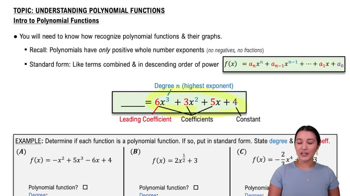
Degree of a Polynomial

The degree of a polynomial is the highest power of the variable in the polynomial expression. For example, in the polynomial f(x) = 3x^4 + 2x^2 + 1, the degree is 4. The degree provides important information about the polynomial's behavior, including the number of roots and the end behavior of its graph.
Video consigliato:
6:04
Introduction to Polynomial Functions

Multiplication of Polynomials

When multiplying polynomials, the degree of the resulting polynomial is the sum of the degrees of the polynomials being multiplied. For instance, if f is an nth-degree polynomial and g is an mth-degree polynomial, then the degree of the product f ⋅ g is n + m. This principle is crucial for determining the degree of polynomial expressions resulting from operations.
Video consigliato:
6:04
Introduction to Polynomial Functions

Composition of Polynomials

The composition of polynomials involves substituting one polynomial into another. For example, if f(x) is a polynomial and g(x) is another, then the composition f(g(x)) results in a new polynomial. While the question focuses on multiplication, understanding composition helps clarify how polynomials interact, especially in more complex expressions.
Video consigliato:
6:04
Introduction to Polynomial Functions
Pratica correlata
Domanda del libro di testo

Symmetry Determine whether the graphs of the following equations and functions are symmetric about the x-axis, the y-axis, or the origin. Check your work by graphing.

ƒ(x)=x5−x3−2ƒ(x)=x{^5}-x^3-2

328
views
Domanda del libro di testo

Symmetry Determine whether the graphs of the following equations and functions are symmetric about the x-axis, the y-axis, or the origin. Check your work by graphing.

x23+y23=1x^{\(\frac\)23}+y^{\(\frac\)23}=1

311
views
Domanda del libro di testo

Evaluating inverse trigonometric functions Without using a calculator, evaluate the following expressions.

tan(tan−11)\(\tan\)\(\left\)(\(\tan\)^{-1}1\(\right\))

257
views
Domanda del libro di testo

Evaluating inverse trigonometric functions Without using a calculator, evaluate the following expressions.

tan−1(tan(3π4))\(\tan\)^{-1}\(\left\)(\(\tan\[\left\)(\(\frac{3\pi}{4}\]\right\))\(\right\))

260
views
Domanda del libro di testo

A culture of bacteria has a population of 150150 cells when it is first observed. The population doubles every 12 hr12~\(\text{hr}\), which means its population is governed by the function p(t)=150⋅2t12p\(\left\)(t\(\right\))=150\(\cdot{2^{\frac{t}{12}\)}}, where tt is the number of hours after the first observation.

How long does it take the population to reach 10,00010,000?

253
views
Domanda del libro di testo

Composition of polynomials

Let ƒ be an nth-degree polynomial and let g be an mth-degree polynomial.

What is the degree of the following polynomials?

ƒ o g

279
views