Ch. 1 - Functions
Briggs - Calculus: Early Transcendentals 3rd Edition
Briggs3rd EditionCalculus: Early TranscendentalsISBN: 9780136847243Non è quello che usi tu?Cambia libro di testo
Capitolo 1, Problema 82

Evaluating inverse trigonometric functions Without using a calculator, evaluate the following expressions.
tan(tan−11)\(\tan\)\(\left\)(\(\tan\)^{-1}1\(\right\))

Guida verificata passo dopo passo
1
Understand the problem: We need to evaluate \( \tan(\tan^{-1}(1)) \). This involves the inverse trigonometric function \( \tan^{-1} \), which is the inverse of the tangent function.
Recall the definition of \( \tan^{-1}(x) \): It is the angle \( \theta \) such that \( \tan(\theta) = x \) and \( \theta \) is in the range \(-\frac{\pi}{2} < \theta < \frac{\pi}{2} \).
Apply the definition to \( \tan^{-1}(1) \): We need to find an angle \( \theta \) such that \( \tan(\theta) = 1 \). The angle \( \theta \) that satisfies this within the range is \( \frac{\pi}{4} \), because \( \tan(\frac{\pi}{4}) = 1 \).
Substitute back into the original expression: Now that we know \( \tan^{-1}(1) = \frac{\pi}{4} \), we substitute this into the expression to get \( \tan(\frac{\pi}{4}) \).
Evaluate \( \tan(\frac{\pi}{4}) \): Since \( \tan(\frac{\pi}{4}) = 1 \), the expression \( \tan(\tan^{-1}(1)) \) simplifies to 1.

Risposta video verificata per un problema simile:

Questa soluzione video è stata consigliata dai nostri tutor come utile per risolvere questo problema.
Durata del video:
1m

Concetti chiave

Ecco i concetti essenziali che devi comprendere per rispondere correttamente alla domanda.

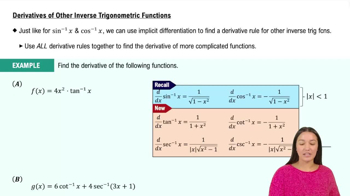
Inverse Trigonometric Functions

Inverse trigonometric functions, such as an^{-1}(x), are used to find the angle whose tangent is x. These functions essentially reverse the action of the standard trigonometric functions. For example, if an( heta) = x, then heta = an^{-1}(x). Understanding these functions is crucial for evaluating expressions involving angles and their corresponding trigonometric ratios.
Video consigliato:
06:35
Derivatives of Other Inverse Trigonometric Functions

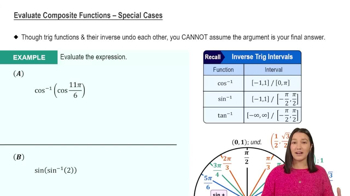
Function Composition

Function composition involves applying one function to the result of another function. In the expression an( an^{-1}(1)), the an^{-1}(1) computes the angle whose tangent is 1, which is rac{ ext{π}}{4} radians. Then, applying the tangent function to this angle returns the original input, demonstrating that an( an^{-1}(x)) = x for all x in the domain of the inverse function.
Video consigliato:
3:48
Evaluate Composite Functions - Special Cases

Trigonometric Values

Trigonometric values are the outputs of trigonometric functions for specific angles. For instance, an( rac{ ext{π}}{4}) equals 1, as the tangent of 45 degrees (or rac{ ext{π}}{4} radians) is 1. Knowing the standard values of trigonometric functions for common angles (0, rac{ ext{π}}{6}, rac{ ext{π}}{4}, rac{ ext{π}}{3}, and rac{ ext{π}}{2}) is essential for quickly evaluating expressions without a calculator.
Video consigliato:
Percorso guidato
6:04
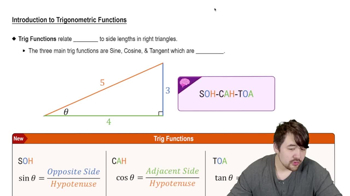
Introduction to Trigonometric Functions
Pratica correlata
Domanda del libro di testo

Symmetry Determine whether the graphs of the following equations and functions are symmetric about the x-axis, the y-axis, or the origin. Check your work by graphing.

ƒ(x)=x5−x3−2ƒ(x)=x{^5}-x^3-2

328
views
Domanda del libro di testo

Composition of polynomials

Let ƒ be an nth-degree polynomial and let g be an mth-degree polynomial.

What is the degree of the following polynomials?

ƒ ⋅ f

386
views
Domanda del libro di testo

Evaluating inverse trigonometric functions Without using a calculator, evaluate the following expressions.

tan−1(tan(π4))\(\tan\)^{-1}\(\left\)(\(\tan\[\left\)(\(\frac{\pi}{4}\]\right\))\(\right\))

281
views
Domanda del libro di testo

Evaluating inverse trigonometric functions Without using a calculator, evaluate the following expressions.

tan−1(tan(3π4))\(\tan\)^{-1}\(\left\)(\(\tan\[\left\)(\(\frac{3\pi}{4}\]\right\))\(\right\))

260
views
Domanda del libro di testo

A culture of bacteria has a population of 150150 cells when it is first observed. The population doubles every 12 hr12~\(\text{hr}\), which means its population is governed by the function p(t)=150⋅2t12p\(\left\)(t\(\right\))=150\(\cdot{2^{\frac{t}{12}\)}}, where tt is the number of hours after the first observation.

How long does it take the population to reach 10,00010,000?

253
views
Domanda del libro di testo

Composition of polynomials

Let ƒ be an nth-degree polynomial and let g be an mth-degree polynomial.

What is the degree of the following polynomials?

ƒ o g

279
views