Ch. 1 - Functions
Briggs - Calculus: Early Transcendentals 3rd Edition
Briggs3rd EditionCalculus: Early TranscendentalsISBN: 9780136847243Non è quello che usi tu?Cambia libro di testo
Capitolo 1, Problema 112c

Daylight function for 40 °N Verify that the function D(t)=2.8sin(2π365(t−81))+12D(t)=2.8\(\sin\)(\(\frac{2\pi}{365}\)(t-81))+12 has the following properties, where t is measured in days and D is the number of hours between sunrise and sunset.


D(81)=12D(81) = 12 and D(264)≈12D(264) ≈ 12  (corresponding to the equinoxes).

Guida verificata passo dopo passo
1
First, understand the function D(t) = 2.8\(\sin\)\(\left\)(\(\frac{2\pi}{365}\)(t-81)\(\right\)) + 12. This function models the number of daylight hours as a sinusoidal function of time, where t is the day of the year.
To verify the property D(81) = 12, substitute t = 81 into the function: D(81) = 2.8\(\sin\)\(\left\)(\(\frac{2\pi}{365}\)(81-81)\(\right\)) + 12. Simplify the expression inside the sine function.
Notice that \(\sin\)(0) = 0, so the expression becomes D(81) = 2.8 \(\times\) 0 + 12 = 12. This confirms that D(81) = 12, which corresponds to the spring equinox.
Next, verify the property D(264) \(\approx\) 12. Substitute t = 264 into the function: D(264) = 2.8\(\sin\)\(\left\)(\(\frac{2\pi}{365}\)(264-81)\(\right\)) + 12. Simplify the expression inside the sine function.
Calculate \(\frac{2\pi}{365}\)(264-81) and find the sine of this angle. Since the sine function oscillates between -1 and 1, the value of D(264) will be close to 12, confirming the property for the autumn equinox.

Risposta video verificata per un problema simile:

Questa soluzione video è stata consigliata dai nostri tutor come utile per risolvere questo problema.
Durata del video:
7m

Concetti chiave

Ecco i concetti essenziali che devi comprendere per rispondere correttamente alla domanda.

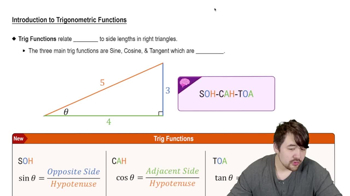
Trigonometric Functions

Trigonometric functions, such as sine, are fundamental in calculus and describe relationships between angles and sides of triangles. In the context of the daylight function, the sine function models periodic phenomena, such as the variation in daylight hours throughout the year. Understanding how to manipulate and interpret these functions is crucial for analyzing the behavior of the function D(t).
Video consigliato:
Percorso guidato
6:04
Introduction to Trigonometric Functions

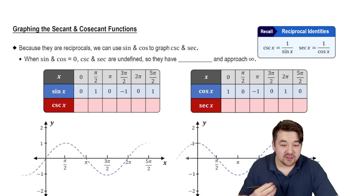
Periodic Functions

A periodic function is one that repeats its values at regular intervals, known as the period. The function D(t) is periodic with a period of 365 days, reflecting the annual cycle of daylight hours. Recognizing the periodic nature of such functions allows for predictions about daylight at any given time of the year, which is essential for solving related problems.
Video consigliato:
Percorso guidato
6:22
Graphs of Secant and Cosecant Functions

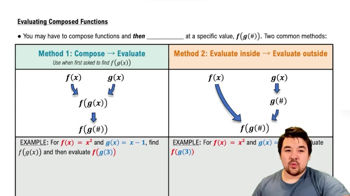
Function Evaluation

Function evaluation involves substituting a specific input value into a function to determine its output. In this case, evaluating D(t) at specific values like t=81 and t=264 helps to understand the function's behavior at key points, such as the equinoxes. Mastery of function evaluation is necessary for analyzing and interpreting the results of the daylight function.
Video consigliato:
Percorso guidato
4:26
Evaluating Composed Functions